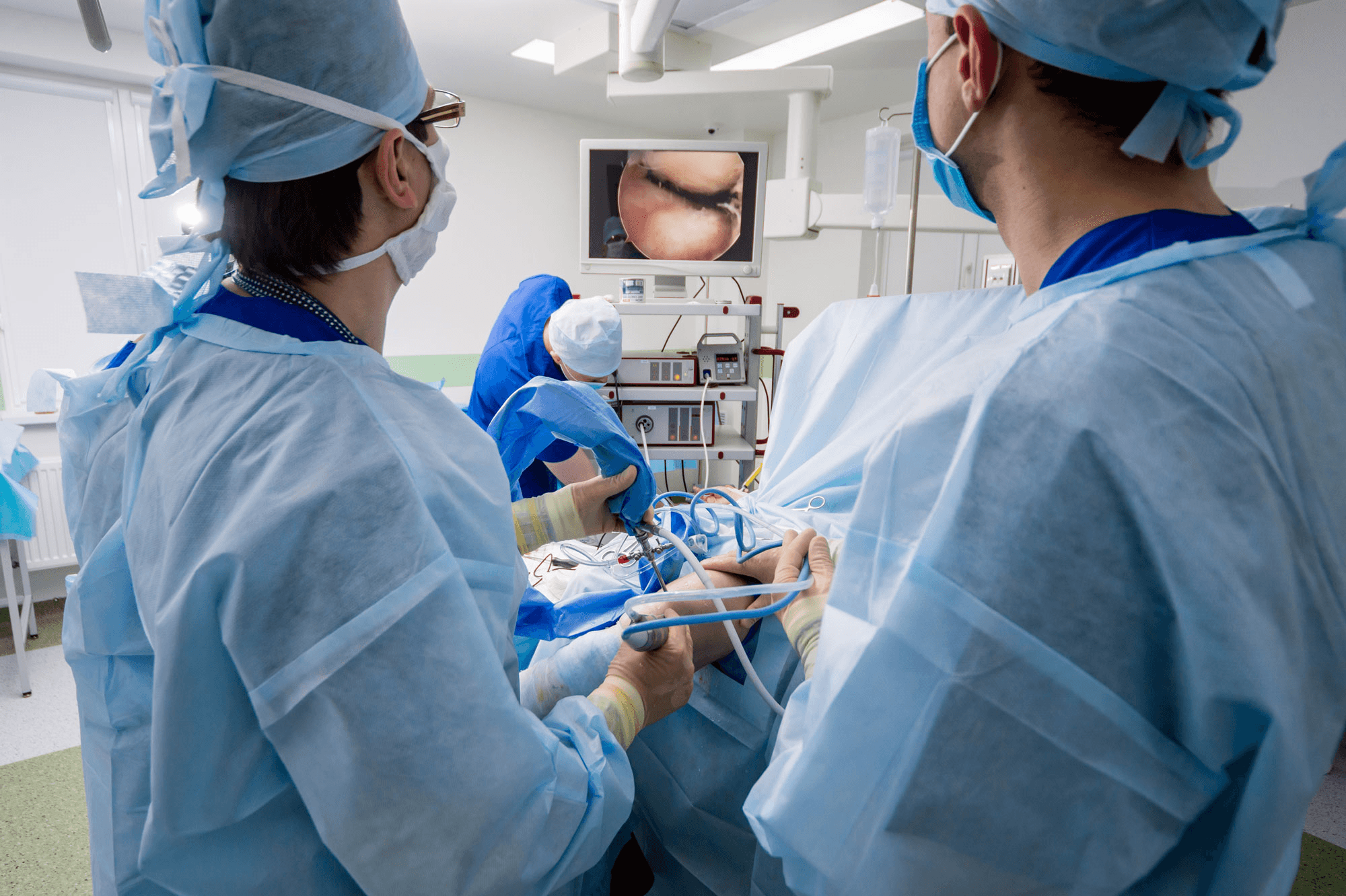

ChondroFiller injection for advanced knee osteoarthritis
Does advanced knee OA rule you out for a ChondroFiller injection?
For most patients told they have Grade III or IV knee osteoarthritis — the range colloquially known as 'bone on bone' — the options presented are stark: manage symptoms with injections or tablets, or wait until the joint warrants a total knee replacement. ChondroFiller injection sits outside that binary.
ChondroFiller® liquid (Meidrix Biomedicals GmbH) is a CE-marked Class III medical device that explicitly includes Kellgren-Lawrence Grade III and IV osteoarthritis within its candidacy. Kellgren-Lawrence grading describes the severity of structural joint change visible on imaging, running from Grade I (minor) through to Grade IV (severe joint-space narrowing and bone-on-bone contact). Grades III and IV mark the range that most conventional cartilage repair trials exclude — yet they are the patients ChondroFiller is designed to reach.
The clinical intent is joint preservation: a staged approach that supports the joint's own repair processes and aims to maintain function before replacement becomes necessary. No injectable treatment can guarantee to prevent a knee replacement, but ChondroFiller injection is positioned as a meaningful non-surgical option where historically none existed for this grade of disease.
Treatment is delivered as an ultrasound-guided outpatient injection at the London Cartilage Clinic on Harley Street — no theatre, no general anaesthesia. Suitability depends not on grade alone but on defect geometry, bone health, synovial involvement, and functional goals; these factors determine which of the available treatment tiers is most appropriate, as the sections that follow explain.
Why Grade III–IV OA sits outside most cartilage repair options
Surgical cartilage repair — microfracture, autologous chondrocyte implantation (ACI/MACI), and osteochondral autograft transfer (OATS) — is designed for focal, contained defects in joints that are otherwise structurally sound. Clinical trials for these procedures typically exclude patients above Kellgren-Lawrence Grade II, and most techniques struggle with defects beyond 4–6 cm². Advanced osteoarthritis is not the same problem: the damage is diffuse, the subchondral bone is compromised, and the joint environment is hostile to the precise tissue engineering these procedures require.
Corticosteroid injection is validated for Grade 2–3 symptom control, but relief is consistently short-lived — research in this area, including the widely cited McAlindon et al. 2017 JAMA trial, has linked repeated intra-articular triamcinolone to progressive cartilage volume loss rather than any structural benefit, raising caution about long-term use. An independent study of triamcinolone acetonide confirmed that moderate-to-severe pain returns in most patients within three months of injection.
Hyaluronic acid acts as a joint lubricant and is cleared from the joint within weeks; it does not provide a scaffold for repair. Arthrosamid, a polyacrylamide hydrogel, cushions the synovial lining but is non-regenerative and does not replace lost cartilage tissue.
For Grade III–IV patients who are too young for total knee replacement, medically unsuitable, or unwilling to proceed to surgery, this leaves a structural gap: a regenerative injectable option capable of working at higher disease grades.
How the ChondroFiller scaffold promotes cartilage repair
The distinction that matters most for patients researching cartilage injections is not brand name — it is what happens to the material after it enters the joint.
ChondroFiller is composed of Type I/III collagen — the same structural protein the body uses to build connective tissue. Injected in liquid form, it gels in situ over worn bone surfaces, creating a three-dimensional matrix within the cartilage defect. That matrix is not an end in itself; it functions as a biological template. The process it initiates is called acellular matrix-induced chondrogenesis — in plain terms, a scaffold that carries no cells of its own but draws the patient's own progenitor cells out of the surrounding synovium and subchondral bone, then gives them a structured environment in which to differentiate and gradually build cartilage-like tissue.
This is what separates ChondroFiller from the other injectable categories a patient will typically encounter. Hyaluronic acid is a lubricant; it does not provide a scaffold and is cleared from the joint within weeks. Polyacrylamide hydrogel (such as Arthrosamid) cushions the synovial lining permanently but does not integrate or remodel. ChondroFiller is designed to be populated and progressively replaced by the body's own tissue — not to remain as a synthetic implant.
The maturation process is measurable. MOCART imaging scores — a validated marker of repair-tissue quality and defect fill — rose from a mean of 65.3 at four weeks to 81.6 at twelve months in clinical study data, confirming that the scaffold is actively remodelled over time rather than simply occupying space.
What the clinical results show for higher-grade OA
Across four knee studies, ChondroFiller produced mean IKDC improvements of approximately 30 points — a figure that matters because the Minimal Clinically Important Difference (MCID) for the IKDC scale is 16.7 points. Any result below that threshold is unlikely to register in daily life; a 30-point gain represents roughly double the bar for change that patients actually feel.
The strongest single study is the Jerosch et al. prospective post-market clinical follow-up (PMCF) investigation, which recorded a mean IKDC improvement of 32.4 points. That gain was not only sustained but slightly increased at three-year follow-up, with patients reaching a mean functional score of 80 — a level consistent with near-normal joint function for many activities.
MOCART scores in European cohorts ranged from 81.6 to 84.3, indicating greater than 80% defect filling with good integration into surrounding native tissue. As the maturation sequence established earlier shows, these imaging results confirm that functional improvement is accompanied by structural change in the joint.
Against microfracture, the comparison is favourable on several specific metrics: ChondroFiller accommodates defects up to 6 cm² versus the fewer than 2–4 cm² that microfracture typically handles, produces hyaline-like rather than fibrocartilage, and carries a reoperation rate of approximately 3–8% compared with up to 41% for microfracture. Against ACI/MACI, functional outcomes are broadly comparable — both achieve approximately 30–35 IKDC points of improvement — but ChondroFiller does so in a single outpatient injection stage at approximately 0% complication rate, versus up to 17% for cell-based therapies.
Two caveats apply. The published data are predominantly manufacturer-sponsored or drawn from European cohorts; independent large-scale RCT evidence specifically for Kellgren-Lawrence Grade III/IV patients is not yet available in the literature. These are real limitations. They do not affect the CE-mark regulatory basis — which required substantial clinical evaluation — nor do they undermine the outcome consistency seen across four separate studies. The evidence is meaningful; it is not yet from a large independent randomised trial.
Treatment tiers: monotherapy, combination, and the Lifetime Program
Three clinical pathways are available, graded by disease severity and patient presentation. Monotherapy is the starting point for most.
Monotherapy ChondroFiller injection
For the majority of KL Grade III/IV patients, a single outpatient ultrasound-guided injection of ChondroFiller (2.3 mL) is the primary pathway. It is the tier with the most direct clinical support — the outcome data described in the preceding section relate principally to this approach. Guide cost ranges from £3,000 to £8,000 depending on the volume of product required; exact figures should be confirmed with the treating clinic.
CFI+ dual injection
Where cartilage loss coexists with significant synovial inflammation — pain at rest, recurrent swelling, or regular flares — a second injection, Arthrosamid, may be added. ChondroFiller and Arthrosamid work at different anatomical sites and through entirely different mechanisms: ChondroFiller lays a biological scaffold over the cartilage defect at the load-bearing bone surface; Arthrosamid integrates into the synovial lining as a long-term mechanical cushion. They are complementary in rationale, not a single blended product. Each component requires separate clinical justification, and direct evidence for the combination is limited — CFI+ has not been shown in controlled trials to slow OA progression or delay knee replacement. Guide cost is approximately £6,000.
Tri-Active Therapy
For extreme presentations, autologous mesenchymal stem cells (derived from the patient's own bone marrow or adipose tissue) can be co-delivered alongside the dual injection. At a guide cost of approximately £11,000, this tier is positioned for the most advanced 'impossible' OA cases. The rationale rests on the individual evidence base for each component rather than combined-therapy trial data.
Longitudinal Lifetime Program
A structured maintenance protocol — annual MRI, annual peptide support, and a two-yearly ChondroFiller top-up injection — is offered as a long-term joint-preservation strategy. The programme is grounded in structural rationale: monitoring for further degeneration and renewing the scaffold before significant tissue loss recurs. There are currently no long-term RCT data confirming it delays total knee replacement; it is a maintenance framework, not a proved TKR-prevention protocol.
Getting assessed at the London Cartilage Clinic
The assessment visit does more than confirm a diagnosis already visible on a scan. Suitability for ChondroFiller injection depends on factors that imaging alone cannot settle: the geometry and depth of the defect, the condition of the surrounding cartilage and subchondral bone, the presence or absence of active synovial inflammation, and what the patient reasonably expects from a biological scaffold rather than a surgical reconstruction.
Some presentations fall outside the candidacy criteria. Active or suspected joint infection, systemic inflammatory disease affecting the joint, poorly controlled diabetes, and immunosuppression are contraindications regardless of radiological grade. Unrealistic expectations of immediate or guaranteed pain relief are also a bar — the scaffold matures over 6–12 months, not days.
The candidacy expansion that distinguishes ChondroFiller from conventional repair options — no fixed age ceiling, 'bone on bone' not automatically disqualifying — still requires individual confirmation rather than online self-assessment.
Professor Paul Y. F. Lee leads ChondroFiller injection delivery at the London Cartilage Clinic on Harley Street. In image-guided scaffold placement, technique precision affects how well the collagen matrix seats against the defect surface and integrates with the surrounding tissue — it is not a commodity injection.
Assessments can be arranged via londoncartilage.com.
- [1] Intra-articular Triamcinolone Acetonide Injection Effectiveness in Knee Joint Pain Patients with Osteoarthritis Grade 2–3 Kellgren Lawrence. (2025). https://doi.org/10.52711/0974-360x.2025.00050 https://doi.org/10.52711/0974-360x.2025.00050
Frequently Asked Questions
- Yes. ChondroFiller is explicitly designed for Kellgren-Lawrence Grade III and IV osteoarthritis, including bone-on-bone cases that conventional repair options typically exclude.
- ChondroFiller is Type I/III collagen that gels in place, creating a biological scaffold. This draws the body's own progenitor cells to differentiate and build cartilage-like tissue over 6–12 months.
- Clinical studies show mean IKDC improvements of approximately 30 points, roughly double the threshold for clinically meaningful change. Results are sustained and often improve at three-year follow-up.
- Three tiers: monotherapy (ChondroFiller alone, £3,000–£8,000), CFI+ (ChondroFiller plus Arthrosamid, £6,000), and Tri-Active Therapy (with autologous stem cells, £11,000). A Lifetime Program offers ongoing maintenance.
- An ultrasound-guided outpatient injection delivered at the London Cartilage Clinic on Harley Street, requiring no theatre or general anaesthesia. The scaffold then matures over 6–12 months.
Next steps
Where to go from here
These routes are selected from the topic and purpose of this article. They are guidance, not a diagnosis or treatment recommendation.
Learn more
Explore liquid cartilage treatment
Use a structured overview to narrow down the most useful next step for your situation.
Talk to the team
Book a free discovery call
A non-medical call with the team to understand services and choose the right booking route.
Legal & Medical Disclaimer
This article is written by an independent contributor and reflects their own views and experience, not necessarily those of Liquid Cartilage. It is provided for general information and education only and does not constitute medical advice, diagnosis, or treatment.
Always seek personalised advice from a qualified healthcare professional before making decisions about your health. Liquid Cartilage accepts no responsibility for errors, omissions, third-party content, or any loss, damage, or injury arising from reliance on this material.
If you believe this article contains inaccurate or infringing content, please contact us at [email protected].