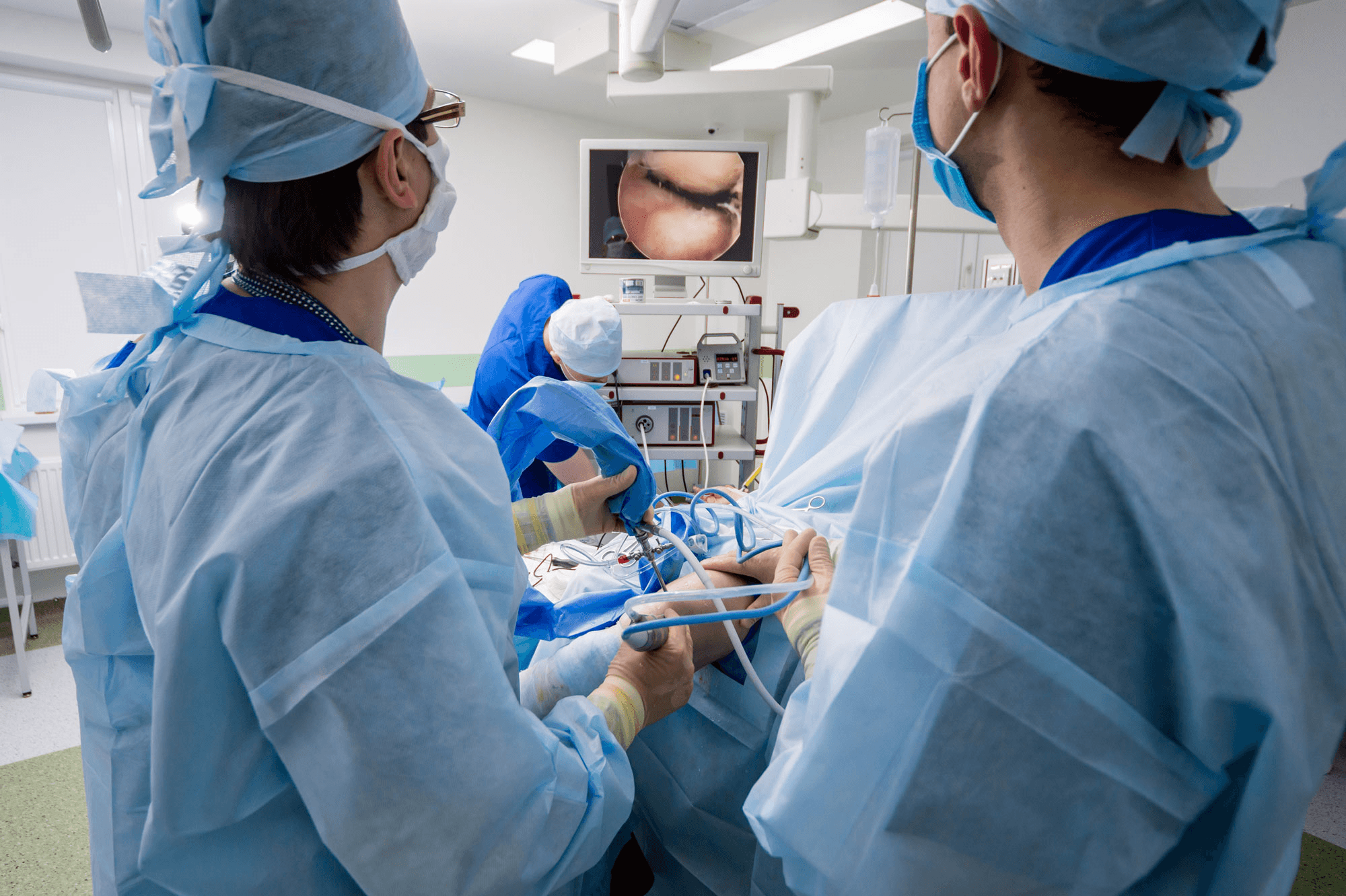

ChondroFiller injection before knee replacement
Is a knee injection a realistic alternative to joint replacement?
For many patients told they are heading for a knee replacement, the honest question is not whether surgery will eventually work — it may well. The question is whether a structural option worth taking first actually exists.
ChondroFiller injection is not a painkiller or a lubricating top-up. It is a CE-marked Class III injectable collagen scaffold — a medical device that gels within the joint and recruits the body's own stem cells to build new cartilage through acellular matrix-induced chondrogenesis. The target is the cartilage structure itself, not the pain signal it produces.
Total knee replacement takes the opposite approach: it removes all remaining native cartilage and resurfaces the entire joint with metal and polyethene implants. Once performed, that is permanent.
For patients with early-to-moderate cartilage damage — or even Kellgren-Lawrence Grade III/IV end-stage osteoarthritis — ChondroFiller injection represents a credible structural intervention before that point of no return is reached. This is a different category from either a palliative injection that masks symptoms or a surgery merely deferred: it is an attempt to preserve and rebuild what is still present in the joint.
What ChondroFiller injection does inside the joint
The collagen solution enters the joint as a liquid and self-gels within minutes on contact with the articular surface, bonding to the cartilage and coating the joint space evenly. That physical stabilisation is only the first part of what happens.
The scaffold's architecture acts as a chemotactic signal. Progenitor cells from the surrounding synovium and subchondral bone migrate into the matrix, where they differentiate into chondrocytes — the specialised cells that produce and maintain cartilage. As those cells begin laying down new tissue at the site of damage, the collagen matrix itself biodegrades, leaving behind the body's own rebuilt cartilage rather than a permanent filler. The scaffold is temporary; its purpose is to support the body's own repair processes, not to remain in the joint indefinitely.
This is what separates ChondroFiller injection from every other injection patients are typically offered. Hyaluronic acid adds lubrication but does not address cartilage structure. Corticosteroid manages acute inflammation without any regenerative action — published evidence indicates cartilage volume loss with repeated use. Arthrosamid, a polyacrylamide hydrogel, provides cushioning within the joint lining and stays there permanently; it does not recruit cells or initiate tissue repair. ChondroFiller injection is the only pathway in this group designed to work through matrix-induced chondrogenesis — an active biological process that targets the cartilage itself.
The injection is carried out under ultrasound guidance as an outpatient appointment on Harley Street, with no general anaesthetic and no hospital stay required.
Free non-medical discussion
Not sure what to do next?
Information only · No medical advice or diagnosis.
The procedural gap between an injection and a knee replacement
Side by side, the two procedures sit at opposite ends of the logistical spectrum — and that gap is worth understanding in concrete terms before any decision is made.
A ChondroFiller injection at the London Cartilage Clinic on Harley Street is an outpatient appointment. The procedure is performed under ultrasound guidance with no general anaesthetic and no hospital admission; patients typically leave the same day. Guide costs run from approximately £3,000 inclusive of consultation, imaging, the product, IV antibiotic cover, and a six-week follow-up — though exact figures should be confirmed with the treating clinic.
Total knee replacement occupies a different tier of intervention entirely. It is performed under general or spinal anaesthetic, requires one to three nights as an inpatient, and carries a full recovery arc of six to twelve months before the joint functions reliably in daily life. The procedure resurfaces the entire joint with metal and polyethene implants.
The point here is not that one option is better than the other — it is that they are not competing for the same moment on the treatment timeline. ChondroFiller injection is a structural intervention that can be taken while native cartilage is still worth preserving; knee replacement is what becomes appropriate once that window has closed. Patients often interpret 'injection versus surgery' as a quality trade-off, choosing between something modest and something thorough. In practice it is a timing decision: the injection aims to delay or avoid the surgical point, not to replicate it. Should TKR ever become necessary later, it remains available.

Who is a candidate for ChondroFiller injection
The eligibility range for ChondroFiller injection is broader than most patients expect. There is no upper age limit and no defect-size restriction — because the scaffold coats the entire articular surface rather than asking the body to bridge a specific gap, the procedure remains viable across joint conditions that would disqualify other approaches.
In practical terms, suitable candidates span Kellgren-Lawrence Grade I through to Grade IV end-stage osteoarthritis. That breadth matters because it includes patients at both ends of a frustrating middle ground: those with early cartilage damage who want to slow progression, and those who have been told they are "not quite bad enough" for total knee replacement yet are too symptomatic to do nothing. The injection pathway is specifically suited to that gap.
Patients who are not suitable for surgery — due to comorbidities, anaesthetic risk, or personal preference — are often well placed for the outpatient injection route.
One biological signal argues for acting sooner rather than later: cartilage has no direct blood supply, meaning focal defects of 1 cm or more carry a real risk of progressive deterioration without scaffolded support. The more native tissue that remains when treatment begins, the wider the structural preservation window.
Where a joint presents with more complex damage, a different tier of treatment may be appropriate — a distinction that requires clinical assessment to establish, not self-screening alone.
Whatthe clinical evidence shows
The strongest outcome signal comes from the manufacturer's Clinical Evaluation Report (CER v09, April 2025) and the independent literature cited within it. In the knee, IKDC scores — a validated composite measure of symptoms, function, and activity — improve by approximately 30 points over twelve months following ChondroFiller injection. A 30-point shift on this scale is widely regarded as clinically meaningful, not a marginal statistical artefact.
Post-treatment MRI adds a structural dimension that analgesic endpoints cannot capture. Imaging confirms reductions in bone marrow oedema, decreased periarticular effusion, and measurable widening of the joint space. These are changes to joint architecture, not simply pain suppression — a distinction that separates ChondroFiller injection from corticosteroid or hyaluronic acid injections, which do not produce MRI-visible structural change of this kind.
The evidence base has two honest limitations. First, the available studies are primarily manufacturer-sponsored; no published independent randomised controlled trial has yet compared ChondroFiller injection to a sham injection in the knee. That gap does not invalidate the existing data, but it means the findings have not yet been tested under the most rigorous conditions. Second, long-term data on joint preservation rates — specifically, how many treated patients avoid total knee replacement at five or ten years — have not yet been published. The current evidence horizon is approximately one year.
Taken together, the picture is credible and clinically meaningful, but still early. Patients considering the treatment should weigh a solid one-year dataset against an absence of decade-long follow-up.
Cartilage preservation as a long-term strategy
Thinking about ChondroFiller injection as a single event misses its fuller value. The more useful frame is ongoing structural management: an initial injection, periodic top-ups roughly every two years, and annual MRI monitoring to track whether structural gains are holding — a preventive maintenance model rather than a one-off repair.
That reframing also changes the question worth bringing to assessment. Rather than asking whether the injection will "fix" the knee, patients are better served by asking what a structured three-to-five-year management plan looks like for their joint. Arriving with an up-to-date MRI scan and a clear account of symptom trajectory and activity demands gives the consulting clinician the most useful starting point for that conversation.
One honest caveat runs through all of this: ChondroFiller injection does not guarantee that total knee replacement will never be needed. Its aim is to extend the structural preservation window — deferring the point at which reconstruction becomes the only option. For some patients that window may be long; for others, more modest. Published follow-up currently extends to approximately one year; longer-term outcome data are not yet available.
The treatment is self-funded and is not currently available on the NHS or through standard private medical insurance. Assessments are offered at the London Cartilage Clinic on Harley Street, where the all-in guide cost starts from £3,000; appointments can be arranged at londoncartilage.com.
What the evidence supports, taken together, is a realistic middle position: not a permanent cure, but a credible method of preserving joint options — and the time and function that go with them.
Frequently Asked Questions
- ChondroFiller is a CE-marked collagen scaffold that gels in the joint and recruits the body's stem cells to rebuild cartilage through matrix-induced chondrogenesis, targeting the cartilage structure itself rather than pain.
- It's an outpatient procedure under ultrasound guidance at Harley Street clinics, with no general anaesthetic or hospital stay. Patients typically leave the same day.
- Suitable candidates span Kellgren-Lawrence Grade I through Grade IV osteoarthritis, with no upper age limit or defect-size restriction. It's viable across varied cartilage damage.
- IKDC scores improve approximately 30 points over twelve months. MRI confirms structural changes including reduced bone marrow oedema and measurable joint space widening, not pain suppression alone.
- Structural management is framed as ongoing: initial injection, periodic top-ups roughly every two years, and annual MRI monitoring. This preventive maintenance model aims to extend the preservation window rather than provide permanent cartilage restoration.
Legal & Medical Disclaimer
This article is written by an independent contributor and reflects their own views and experience, not necessarily those of Liquid Cartilage. It is provided for general information and education only and does not constitute medical advice, diagnosis, or treatment.
Always seek personalised advice from a qualified healthcare professional before making decisions about your health. Liquid Cartilage accepts no responsibility for errors, omissions, third-party content, or any loss, damage, or injury arising from reliance on this material.
If you believe this article contains inaccurate or infringing content, please contact us at [email protected].