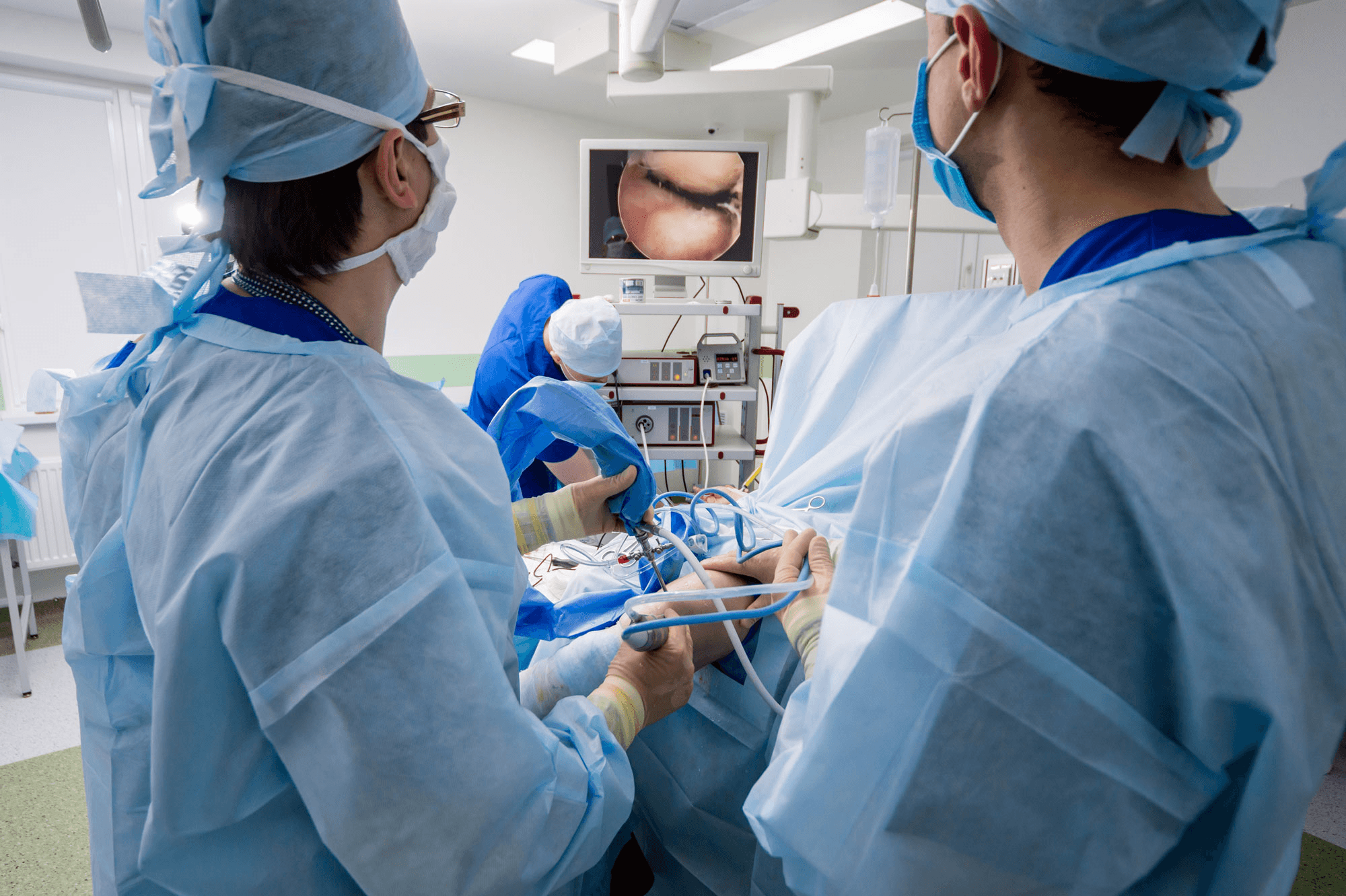

What your ChondroFiller injection appointment involves
The appointment at a glance
For most patients, the first question is simple: what is actually going to happen when I arrive? The answer, in practical terms, is that the ChondroFiller injection appointment is a single focused outpatient visit — no hospital admission, no general anaesthetic, and no surgical incision.
The appointment runs to roughly one hour and follows a fixed sequence. Professor Paul Y. F. Lee begins by reviewing your existing imaging and mapping the cartilage defect in detail. A written treatment plan is then agreed with you before anything else takes place. The injection itself follows, delivered at the London Cartilage Clinic on Harley Street.
Intravenous antibiotic cover is included as standard, as is a six-week clinical follow-up appointment — neither is billed as an add-on. You leave the same day. By the time you do, the collagen scaffold will already have begun setting within the joint — but the mechanism behind that is covered in the sections that follow.
Reviewing your scans and mapping the defect
Mapping the defect is not a formality. Because the collagen scaffold is directed to a specific site rather than dispersed through the joint broadly, the clinician needs a precise picture of where the damage sits, how large an area it covers, and what condition the surrounding cartilage and subchondral bone are in.
Existing MRI and any other imaging is worked through at this stage to confirm defect position, depth, and extent. Where the imaging raises questions about joint suitability or contraindications, those are resolved before the needle is placed.
From this review, the treating clinician establishes the coverage plan: which compartment or compartments will receive the scaffold, and in what volume. That determination also informs how many boxes of ChondroFiller are required — most focal defects are addressed with one, while larger or multi-compartment involvement may require two or three. The written treatment plan reflects these specifics — defect location, coverage area, product volume — and is agreed with the patient before the appointment moves to the injection itself.
Free non-medical discussion
Not sure what to do next?
Information only · No medical advice or diagnosis.
How ultrasound guides the needle into position
Throughout the injection, the clinician watches a live ultrasound image on screen — not a scan taken beforehand, but a continuous feed that updates in real time as the needle advances into the joint.
This distinction matters in practice. With a landmark-based technique, the clinician enters the joint using surface anatomy alone: the needle goes in, and the assumption is that it has reached the correct space. With real-time guidance, there is no assumption. The needle tip is visible on screen at every stage, and the collagen scaffold is not released until the image confirms it is correctly seated within the intra-articular space. That confirmation step — placing before deploying — is the practical safety margin that landmark injection cannot offer.
The second function of the guidance is directional. Because the defect has already been mapped during the consultation, the treating clinician knows precisely where within the joint the scaffold needs to be deposited. The live image allows delivery to be directed toward that target area rather than dispersed into the joint space in general — a meaningful difference when the objective is to coat a specific load-bearing surface.
Taken together, confirmed placement and directed delivery make technique precision central to what the procedure achieves. Professor Paul Y. F. Lee's use of real-time ultrasound is built into the appointment as standard; it is not an optional upgrade applied selectively.

How the collagen gels inside the joint
ChondroFiller arrives in the joint as a liquid. Specifically, it is a solution of acid-extracted Type I collagen — no mixing before the injection, no crosslinking agent added, and no surgical preparation of the cartilage bed required beforehand. The liquid state is what makes needle delivery possible in the first place.
What causes it to set is simply heat. At body temperature, the collagen solution undergoes polymerisation — the protein chains organise into a stable three-dimensional gel without any external catalyst or further clinical step. This happens within minutes of the liquid entering the joint, and it happens entirely inside the joint.
Once set, the gel distributes across the load-bearing articular surfaces of the treated compartment, coating them from above. The practical effect is that worn cartilage surfaces, which have lost their natural cushioning function, gain an immediate physical shock-absorbing barrier between bone and mechanical load. The scaffold does this work structurally, in position, from the moment it solidifies — it does not rely on new tissue forming first in order to be protective.
The entire sequence — liquid entry, thermal set, gel formation, surface coating — is single-stage. Nothing further is done to the joint to achieve it. Biological activity follows later, as the set scaffold begins to recruit the body's own cells; that is a separate process described in the next section.
What the scaffold does over the following months
The set gel doesn't merely provide immediate mechanical cushioning — it begins to change the biological environment of the joint. The polymerised collagen matrix acts as a chemotactic scaffold, drawing in the body's own repair cells through the signalling properties of the collagen itself. Stem cells from the surrounding synovium and progenitor cells from the subchondral bone migrate into the structure in the weeks that follow.
Once inside the matrix, those recruited cells mature into chondrocytes — the specialised cells responsible for producing cartilage — and begin depositing native cartilage matrix. This is acellular matrix-induced chondrogenesis: a scaffold that carries no living cells of its own, but triggers the body's own repair response by providing the structural and chemical cues those cells need. As endogenous cartilage forms, the collagen scaffold gradually resorbs. It is not a permanent implant; it is a temporary framework designed to be replaced by the tissue it helped to create.
Clinical data give some measure of what this process produces. In published studies, IKDC scores — a validated measure of knee function — improved by approximately 30 points over 12 months following ChondroFiller injection. Post-treatment MRI has demonstrated corresponding structural changes: reduction in bone marrow oedema, diminished periarticular effusion, and measurable widening of the joint space. These are objective imaging findings, and they suggest that the biological sequence the scaffold initiates produces detectable change at a tissue level.
The six-week follow-up and what comes next
Six weeks after the injection, an included follow-up appointment shifts the clinical focus from what was done to how the joint is responding — early tolerability, any residual swelling, and whether symptoms are tracking in the expected direction.
Where objective confirmation is useful, post-injection MRI can document structural change: bone marrow oedema reduction, periarticular effusion changes, and joint space widening consistent with imaging findings reported in published series. Symptom scores capture how a joint feels; MRI findings capture what has actually changed at a tissue level — and for many patients, the two lines of evidence together give a fuller picture of response than either would alone.
That convergence — immediate mechanical protection from the moment the gel sets, followed by measurable structural repair over the months that follow — is what separates ChondroFiller injection from symptom-management options at the same stage of the cartilage pathway.
The ChondroFiller injection is delivered in the UK at the London Cartilage Clinic on Harley Street, the UK's certified delivery centre for the product. For patients considering a cartilage assessment, appointments are available via londoncartilage.com.
Frequently Asked Questions
- The appointment runs approximately one hour and includes imaging review, treatment planning, the injection itself, and intravenous antibiotic cover as standard.
- No. It is a single outpatient visit with no hospital admission, no general anaesthetic, and no surgical incision required.
- Real-time ultrasound imaging allows the clinician to watch the needle tip advance on screen. The scaffold is released only when the image confirms correct placement within the joint space.
- The liquid collagen solution undergoes polymerisation at body temperature, organising into a stable gel within minutes without mixing or external catalysts.
- Post-treatment MRI shows reduction in bone marrow oedema, diminished periarticular effusion, and measurable joint space widening. IKDC scores improved approximately 30 points over 12 months.
Legal & Medical Disclaimer
This article is written by an independent contributor and reflects their own views and experience, not necessarily those of Liquid Cartilage. It is provided for general information and education only and does not constitute medical advice, diagnosis, or treatment.
Always seek personalised advice from a qualified healthcare professional before making decisions about your health. Liquid Cartilage accepts no responsibility for errors, omissions, third-party content, or any loss, damage, or injury arising from reliance on this material.
If you believe this article contains inaccurate or infringing content, please contact us at [email protected].