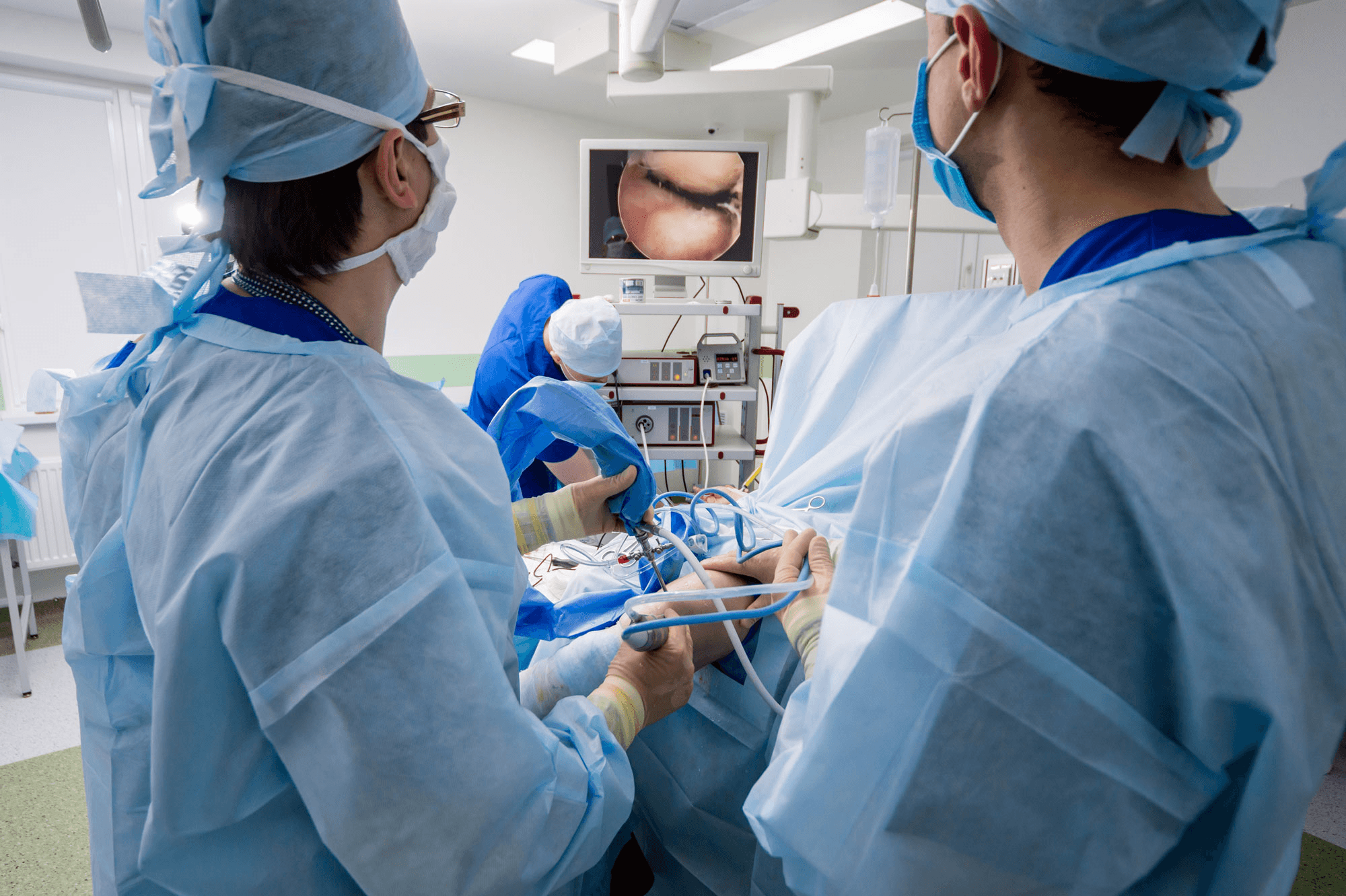

Hip impingement and cartilage damage
How FAI damages cartilage over time
Every time the hip moves into deep flexion — sitting down sharply, squatting, swinging the leg through in a sprint — the femoral head and acetabular rim come into contact. In a normally shaped hip that contact is smooth and distributed. In femoroacetabular impingement (FAI) it becomes a collision.
Cam-type FAI involves a non-spherical femoral head: the bony prominence at the head–neck junction bumps into the anterosuperior rim of the socket on flexion, grinding and shearing the acetabular cartilage in what the Beck clock-face classification calls Zone 2 — roughly the 12-to-2-o'clock position. Pincer-type FAI works differently: an over-covered or retroverted socket pinches the labrum and cartilage circumferentially between the rim and the femoral neck. In practice, many patients have elements of both, and the damage patterns overlap.
What makes FAI-related cartilage injury distinctive is its mode of failure. Rather than wearing down evenly, the cartilage tends to debond from the subchondral bone beneath it while the surface still looks largely intact — the so-called carpet lesion or acetabular cartilage delamination (ACD). On examination or even on standard imaging, the carpet can appear undisturbed; the damage is hidden underneath it. This is one reason why the severity of chondral injury in FAI is frequently underestimated before surgery.
The mechanism is cumulative. No single movement causes a carpet lesion; it is the repetitive loading of dozens of flexion cycles per day, month after month, that tips focal debonding into structural loss. Given that FAI is estimated to underlie more than 75% of hip osteoarthritis cases, the downstream consequences of that quiet, repetitive damage are anything but rare.
Why hip cartilage cannot repair itself
Articular cartilage has no blood supply. Nutrients reach the chondrocytes — the cells responsible for maintaining the matrix — entirely by diffusion through synovial fluid, which means no repair cells can migrate to a defect site when one forms. Unlike bone, which can remodel, or muscle, which can regenerate, cartilage left with a focal lesion stays damaged.
The mechanical consequences compound this biological limitation. Once a gap opens in the cartilage surface, shear stress concentrates at the defect rim rather than distributing evenly across the joint. That stress progressively breaks down the rim, widens the lesion, and — in time — exposes the subchondral bone beneath. Exposed bone drives marrow oedema and cyst formation, the recognised precursors to diffuse osteoarthritis across the joint.
No long-term prospective trials follow hip chondral defects in real time; what the evidence rests on is structural imaging and cross-sectional data. Those data consistently point in one direction: defects grow, and the cascade accelerates once subchondral bone is involved. The natural endpoint, without intervention, is a joint that can no longer be preserved.
Free non-medical discussion
Not sure what to do next?
Information only · No medical advice or diagnosis.
Diagnosing and grading chondral damage in FAI
Scanning the hip gives clinicians a great deal of information — but not always the complete picture of how far cartilage damage has progressed.
Standard MRI demonstrates satisfactory sensitivity and specificity for acetabular chondral lesions and is typically the first imaging step after clinical examination. MR arthrography (MRA) — where contrast is injected directly into the joint before scanning — is theoretically more informative, but its sensitivity is inconsistent in practice. The hip is a deep, constrained joint; limited distensibility means contrast fluid may not spread evenly enough to expose every area of delamination.
Radiologists reading an MRA look for three characteristic signs of hidden delamination: the carpet phenomenon (cartilage that appears structurally intact but has lifted away from bone beneath), the wave sign (the cartilage bulges outward when compressed by contrast pressure), and the inverted Oreo cookie sign (contrast tracking between cartilage layers). Spotting these requires experience, and their absence on a scan does not guarantee the cartilage is sound.
When a lesion is found, surgeons grade it using the Modified Outerbridge scale (Grade 0, normal, through to Grade IV, exposed subchondral bone) or the hip-specific Beck classification (cleavage, debonding, flap, and exposed bone). These frameworks guide treatment decisions rather than predict symptoms alone.
The most important caveat is this: a 2025 scoping review found that MR and arthroscopic grades were discordant in ten of sixteen studies examined. Pre-operative imaging frequently underestimates lesion severity. Arthroscopy remains the only way to characterise damage with certainty — and when it is performed, it can also be the first step in addressing what is found.

What conservative care can and cannot do
For most patients, the first step is not a procedure — it is a structured programme of physical therapy, and this is the right starting point.
Core and hip stabiliser strengthening, movement retraining, and deliberate avoidance of provocative loads (deep squatting, high-impact pivoting, prolonged sitting with the hip in flexion) can meaningfully reduce pain and improve day-to-day function, particularly in patients with lower-grade lesions or where surgical risk is a significant consideration. Conservative care works by reducing the mechanical stress reaching the damaged cartilage zone — essentially buying the joint a better environment to function in.
What it cannot do is reverse the structural deficit. Physiotherapy does not regenerate cartilage, and it does not correct the underlying bony morphology driving the impingement. Pain may settle; the lesion does not shrink.
For that reason, the conservative trial should be defined — a clear programme with agreed goals and a realistic timeframe — rather than open-ended. If a patient has completed a structured course and symptoms remain disabling or function has not recovered to an acceptable level, that is the appropriate moment for specialist reassessment and a conversation about what further options exist.
Treatment options when conservative care reaches its limit
When a structured conservative programme has not restored acceptable function, the decision shifts to what the joint actually needs — and that depends on lesion severity, underlying bony morphology, and individual patient circumstances.
Addressing morphology and cartilage together
Hip arthroscopy for FAI addresses both problems at the same time. Reshaping the cam or pincer deformity without repairing the cartilage leaves damage exposed to ongoing mechanical stress; repairing the cartilage without correcting the impingement leaves the cause in place. The two cannot usefully be separated.
Surgical cartilage repair
Microfracture is the most extensively studied technique. By perforating subchondral bone it triggers a marrow clot that matures into fibrocartilage — biomechanically inferior to native hyaline cartilage but capable of filling the defect. In published series, approximately 60–77% of patients avoid total hip replacement at ten-year follow-up, with around 80–90% of athletes returning to sport within six to eight months.
Newer approaches — chitosan scaffolds, microfragmented adipose tissue transplantation (MATT), fibrin adhesive fixation, and the chondral nail technique described in 2024 — aim to produce biologically superior repair tissue. Favourable early results have been reported for each, but head-to-head randomised data against microfracture do not yet exist, so direct durability comparisons cannot yet be drawn.
Injectable scaffold pathway
Where theatre-based surgery is not indicated or not preferred — earlier-stage lesions, significant surgical risk, or cases where the chondral defect is the primary concern without complex bony deformity — an injectable collagen scaffold (ChondroFiller injection) offers an outpatient alternative. Delivered under ultrasound guidance, the scaffold gels within the defect and recruits the patient's own progenitor cells through matrix-induced chondrogenesis. This pathway is not equivalent to arthroscopic repair and is not appropriate for all defect types; specialist assessment is needed to determine whether lesion geometry and patient profile make it suitable.
Predictors of outcome
Across all modalities, the same variables consistently predict poorer results: age over 35, higher BMI, larger defects, and pre-existing osteoarthritis at Tönnis grade 2 or above. Patients who reach intervention once diffuse joint changes have established carry a materially higher risk of eventually requiring total hip replacement — which is why the timing of that decision matters.
When to seek specialist assessment
The biological case for acting before OA becomes established is straightforward: once subchondral bone is involved and joint-space narrowing has begun, the options narrow with it. Patients under 50 with persistent groin pain that has not responded to a defined physiotherapy programme — particularly where there is suspected labral involvement or imaging showing chondral lesion with early subchondral change — warrant specialist review before that window closes.
The assessment should address both the bony morphology and the cartilage lesion explicitly. Evaluating one without the other leaves part of the pathological process unaccounted for, and the treatment plan is weaker for it.
Which specific pathway is appropriate — continued conservative management, an injectable scaffold, or arthroscopic repair — depends on lesion grade, defect geometry, and individual patient factors: variables that can only be determined at a clinical assessment, not from imaging alone. For London-based patients, the London Cartilage Clinic on Harley Street offers specialist assessment across this pathway, including evaluation for ChondroFiller injection where the lesion and patient profile make it suitable. Appointments can be arranged via londoncartilage.com.
Frequently Asked Questions
- A carpet lesion describes acetabular cartilage that separates from underlying bone whilst the surface appears intact. The damage is hidden from standard imaging and typically only discovered during arthroscopy, which is why severity is often underestimated.
- No. Hip cartilage lacks blood supply, so repair cells cannot reach the injury. Unlike bone or muscle, cartilage cannot regenerate. Once damaged, it remains permanent unless surgically repaired.
- In femoroacetabular impingement, abnormal bone shape causes repetitive grinding during movement. This cumulative daily loading—dozens of flexion cycles—causes debonding that progressively widens into structural cartilage loss.
- Physiotherapy reduces pain and improves function by lowering stress on damaged cartilage, particularly in lower-grade lesions. However, it cannot regenerate cartilage or correct the underlying bony abnormality causing impingement.
- Patients under 50 with persistent groin pain unresponsive to structured physiotherapy warrant specialist review, particularly if imaging shows cartilage lesion with early subchondral changes. Early intervention prevents progression to osteoarthritis.
Legal & Medical Disclaimer
This article is written by an independent contributor and reflects their own views and experience, not necessarily those of Liquid Cartilage. It is provided for general information and education only and does not constitute medical advice, diagnosis, or treatment.
Always seek personalised advice from a qualified healthcare professional before making decisions about your health. Liquid Cartilage accepts no responsibility for errors, omissions, third-party content, or any loss, damage, or injury arising from reliance on this material.
If you believe this article contains inaccurate or infringing content, please contact us at [email protected].