
Diagnosing a Focal Hip Cartilage Defect
What a focal cartilage defect actually is
Being told you have a cartilage defect in your hip raises an immediate question: is this the same thing as arthritis, and how serious is it? The short answer is no — a focal chondral defect is not arthritis, and understanding the difference matters for what happens next.
The hip is a ball-and-socket joint lined with hyaline cartilage — a smooth, load-bearing tissue that covers both the femoral head (the ball) and the acetabulum (the cup). In osteoarthritis, that lining thins progressively across broad areas of the joint surface. A focal cartilage defect is something different: a localised zone of cartilage loss, sometimes no larger than a fingertip, set within an otherwise intact joint. The surrounding cartilage may be largely healthy, which is exactly why early intervention can still make a meaningful difference.
What makes focal defects particularly easy to miss — both for patients and sometimes on initial imaging — comes down to cartilage biology. Hyaline cartilage contains no blood vessels and no nerve endings. Because it cannot sense damage directly, pain does not arise from the cartilage itself; it is generated indirectly, through the subchondral bone beneath, the joint lining (synovium), or the adjacent labrum when abnormal load is transmitted through the defect. This means the structural damage may predate noticeable symptoms by months or even years. Many patients arrive at a specialist clinic having put the discomfort down to a groin strain, tight hip flexors, or the after-effects of sport — only for imaging to reveal a lesion that has been quietly present for some time.
A focal defect does not inevitably progress to osteoarthritis, but cartilage has no meaningful capacity for self-repair. Without the stimulus to heal and with continued mechanical loading, an unaddressed lesion may enlarge over time. Earlier identification, before the surrounding cartilage is compromised, keeps the greatest range of options open.
How focal hip cartilage damage develops
Most focal hip cartilage defects in younger and middle-aged active patients trace back to a single structural problem: femoroacetabular impingement (FAI). FAI arises when the shape of the femoral head, the acetabular rim, or both creates a mechanical mismatch — a slight irregularity that would be unremarkable at rest but generates repeated shear stress every time the hip moves through its range of motion.
Two variants produce cartilage damage in slightly different locations. In cam-type FAI, a bony prominence on the femoral head-neck junction grinds against the acetabular rim during flexion, typically damaging the anterosuperior cartilage of the femoral head. In pincer-type FAI, over-coverage of the acetabulum impinges on the labrum and the adjacent cartilage at the acetabular rim. Because the labrum and the cartilage share a vulnerable zone at the rim, labral tears and chondral defects frequently co-exist — an MRI showing both is not unusual and does not mean two separate injuries occurred. The labrum essentially acts as a warning sign: damage there often points to concurrent cartilage involvement that warrants direct assessment.
Acute trauma — a hip dislocation or high-energy direct impact — can produce an immediate focal defect on either the femoral head or acetabulum. Prior hip surgery is a further risk factor, since altered joint mechanics following any intra-articular procedure may accelerate localised cartilage wear over time.
Recognising the underlying cause matters not just for understanding but for planning: a cam or pincer deformity that remains unaddressed continues generating the same shear forces that created the defect in the first place.
Free non-medical discussion
Not sure what to do next?
Information only · No medical advice or diagnosis.
What imaging shows — and what it can miss
Four distinct imaging tools contribute to a complete hip cartilage assessment, each answering a different question — and each with limits the others are designed to cover.
Plain radiographs are always first. They show bone morphology, joint space narrowing, loose bodies, and any cam or pincer deformity — useful context for staging and for identifying structural contributors to impingement. Cartilage itself is not visible on plain X-ray; a radiograph can look entirely normal in a hip carrying a significant chondral defect.
Standard MRI is the primary tool for chondral lesion detail, providing information on lesion depth and underlying bone involvement. One limitation deserves direct acknowledgement: partial-thickness defects — the lesions most likely to be amenable to early intervention — can still escape detection on conventional sequences. A normal MRI does not exclude chondral damage, and persistent unexplained hip pain after a negative scan warrants further investigation rather than simple reassurance.
MRI arthrogram — standard MRI combined with intra-articular gadolinium contrast — is the preferred modality when FAI or labral pathology is clinically suspected. Distending the joint with contrast opens the narrow cartilage-labrum interface and improves detection of partial-thickness lesions and labral tears that a non-contrast study may miss. It is not first-line for every presentation, but should be considered whenever the clinical picture points to impingement.
For structured whole-joint assessment, the SHOMRI (Scoring Hip Osteoarthritis with MRI) system grades multiple hip compartments using a reproducible, semi-quantitative framework specific to the hip.
Advanced compositional sequences — dGEMRIC for glycosaminoglycan mapping, and T2/T1ρ relaxation mapping — can detect biochemical cartilage degradation before any structural loss appears on standard imaging. These are not part of routine assessment for most patients, but provide a relevant explanation for those with ongoing symptoms and a conventionally normal scan.

ICRS grading — what the numbers mean clinically
Grade numbers appear on MRI reports and orthopaedic letters, but rarely with an explanation of what the scale means — or what it implies for the options still available.
The ICRS (International Cartilage Repair Society) system runs from Grade 0 to Grade 4. Grade 0 is normal cartilage. Grade 1 involves superficial softening or surface blistering without meaningful depth loss. Grade 2 means the lesion extends less than halfway through the cartilage thickness. Grade 3 extends beyond 50% of cartilage depth and is divided into four sub-grades based on exactly how far that penetration goes:
- 3A — the defect stops above the calcified cartilage layer
- 3B — it reaches the calcified layer
- 3C — it penetrates through the calcified layer but stops short of subchondral bone
- 3D — surface blistering with deeper underlying loss of more than 50%
The 3C and 3D sub-grades carry direct clinical weight: at these depths, bone-level involvement begins to close off some regenerative options that remain viable at 3A or 3B. Grade 4 is the threshold at which subchondral bone is exposed — a qualitative shift that limits cartilage-preserving strategies and may move the conversation towards joint replacement planning.
Grade alone, however, does not determine treatment tier. Defect surface area operates as a second axis: lesions under approximately 2 cm² are generally classed as small-focal; those exceeding 2–4 cm² may require different repair strategies. A small Grade 3B lesion and a large Grade 3D lesion sit in different parts of the decision framework despite sharing the same headline grade.
The grade assigned on MRI may also be provisional. Direct inspection, where the hip is assessed arthroscopically, allows probing of lesion depth and evaluation of surrounding cartilage stability — information that can refine an initial imaging classification.
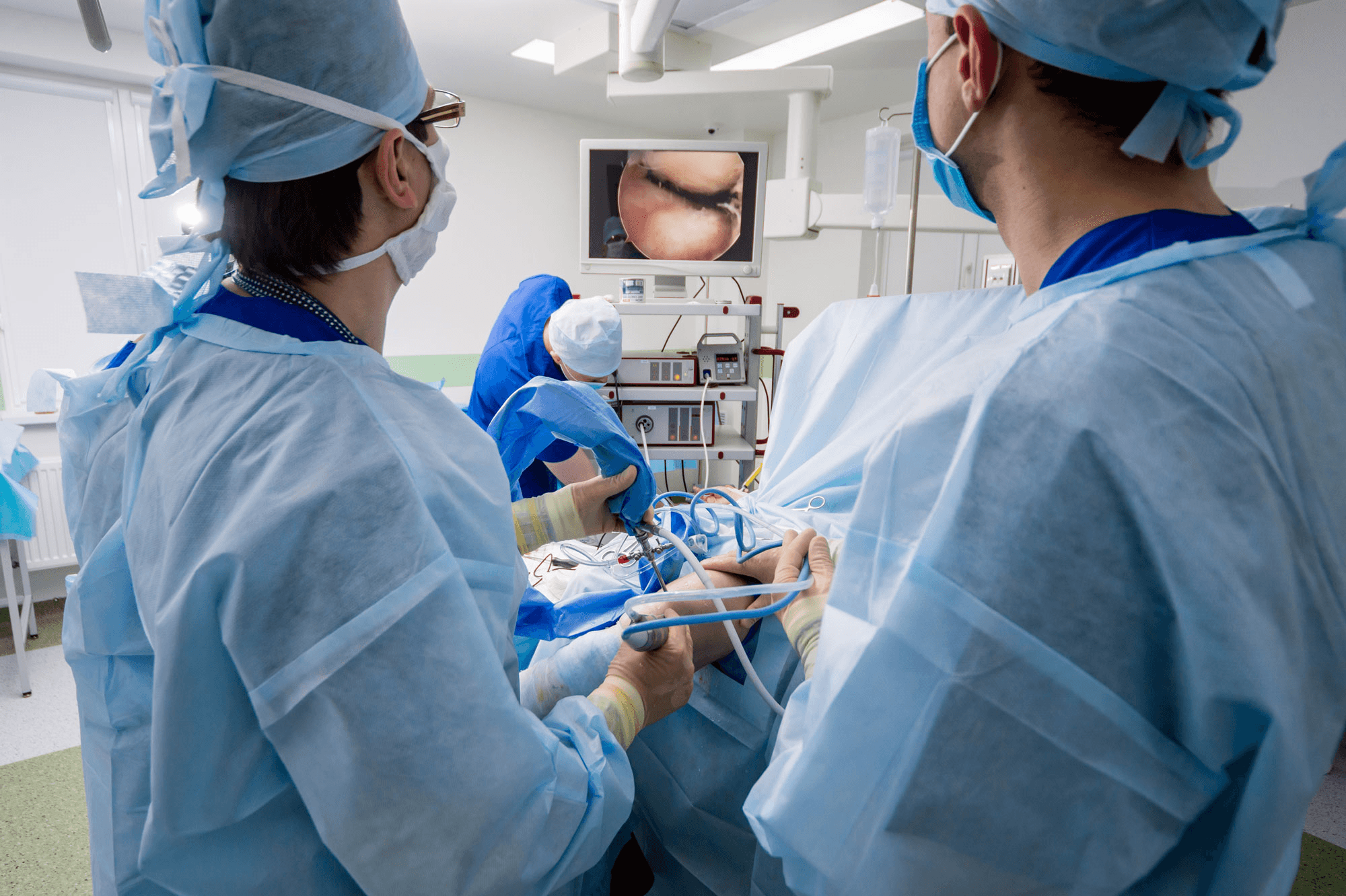
Arthroscopy — when direct inspection changes the picture
The short answer to the question many patients ask — whether they need a camera in the hip just to find out what is wrong — is: not always, but sometimes imaging leaves questions that only direct inspection can resolve.
In the broader articular cartilage literature, arthroscopy is consistently cited as the gold standard for ICRS grading in vivo; hip-specific grading series support the same principle, though the evidence base for the hip is somewhat thinner than for the knee or ankle. In practice, the advantage is tangible: a probe can test lesion depth and the mechanical stability of the surrounding cartilage margin in a way that MRI cannot replicate. The same procedure also allows simultaneous assessment of labral integrity, FAI morphology, and any loose bodies — context that feeds directly into the treatment decision rather than adding a separate diagnostic step.
Not every patient reaches arthroscopy as a diagnostic stage. When MRI arthrogram findings are clear and consistent with symptoms, the surgical assessment can often be deferred until a treatment decision is actively being made, rather than brought forward purely to confirm what imaging has already established.
Arthroscopy becomes more clinically warranted in three situations: there is a discrepancy between symptom severity and imaging findings; a partial-thickness lesion on MRI is ambiguous about its true depth; or the clinical team needs a confirmed ICRS grade before committing to a specific repair or regenerative strategy. In each case, the procedure changes the picture — it does not simply restate it.
From diagnosis to a treatment decision
Two clinical axes determine which treatment tier applies after a confirmed diagnosis: ICRS grade and defect surface area. Both must be read alongside the patient's age, activity demands, and any co-existing structural pathology — labral damage and unaddressed FAI mechanics are particularly relevant because they affect symptom load and the long-term environment any repair must survive.
Conservative care comes first for most patients. Unless the structural picture or symptom severity demands earlier escalation, the typical starting point is activity modification, targeted physiotherapy, and analgesic support. This stage is not passive — addressing movement patterns and load distribution early can slow symptom progression and creates a clearer baseline for monitoring.
For lower-grade, smaller-area defects — broadly Grade 2 or Grade 3A/3B lesions under approximately 2 cm² in a patient without major bone involvement — cartilage-preserving and regenerative approaches are generally in scope. These include injectable collagen scaffold treatment (such as the ChondroFiller injection, delivered as an outpatient procedure using ultrasound-guided image placement), biological injection therapies, and arthroscopic cartilage procedures where FAI correction or labral repair is also needed. The appropriate option within this tier depends on the whole clinical picture, not the ICRS number alone.
Higher-grade or larger-area lesions — Grade 3C, 3D, or Grade 4, or defects exceeding 2–4 cm² — may sit within the surgical repair tier: procedures such as ACI/MACI or osteochondral grafting. When subchondral bone involvement is substantial and the surrounding joint shows broader degeneration, joint replacement planning enters the conversation.
Outcome data do exist as reference points. In published ChondroFiller series, Harris Hip Score improvements of approximately 33 points and MOCART MRI regeneration scores in the 70–87 range have been reported — figures that give some calibration, though outcomes vary with defect size, location, surrounding tissue quality, and the specific treatment selected. A specialist assessment is needed to determine which of these tiers and options applies to any individual's defect profile.
- [1] Osteoarthritis. https://en.wikipedia.org/?curid=504841 https://en.wikipedia.org/?curid=504841
- [2] Hyaline cartilage. https://en.wikipedia.org/?curid=1130627 https://en.wikipedia.org/?curid=1130627
- [3] Femoroacetabular impingement. https://en.wikipedia.org/?curid=20754811 https://en.wikipedia.org/?curid=20754811
- [4] Articular cartilage damage. https://en.wikipedia.org/?curid=19057920 https://en.wikipedia.org/?curid=19057920
Frequently Asked Questions
- A focal defect is localised cartilage loss within an otherwise intact joint; arthritis involves progressive thinning across broad areas. In focal defects, surrounding cartilage may remain largely healthy, which is why early intervention can still make a meaningful difference.
- Hyaline cartilage lacks blood vessels and nerve endings, so pain arises indirectly from the subchondral bone, joint lining, or labrum when abnormal load is transmitted through the defect. Damage may predate symptoms by months or years.
- Femoroacetabular impingement (FAI) is a mechanical mismatch in hip shape causing repeated shear stress. Cam-type FAI damages anterosuperior cartilage of the femoral head; pincer-type damages the acetabular rim and labrum. Acute trauma and prior hip surgery are also risk factors.
- Small focal defects (Grade 2 or Grade 3A/3B under 2 cm²) may be treated with injectable collagen scaffolds, biological injections, or arthroscopic procedures when FAI or labral repair is required. Treatment choice depends on the full clinical picture.
- Lesions under approximately 2 cm² are classed as small-focal and generally suited to cartilage-preserving approaches. Defects exceeding 2–4 cm² may require different repair strategies such as ACI/MACI or osteochondral grafting, particularly with higher grades or bone involvement.
Legal & Medical Disclaimer
This article is written by an independent contributor and reflects their own views and experience, not necessarily those of Liquid Cartilage. It is provided for general information and education only and does not constitute medical advice, diagnosis, or treatment.
Always seek personalised advice from a qualified healthcare professional before making decisions about your health. Liquid Cartilage accepts no responsibility for errors, omissions, third-party content, or any loss, damage, or injury arising from reliance on this material.
If you believe this article contains inaccurate or infringing content, please contact us at [email protected].