
ChondroFiller injection vs surgical cartilage repair
One procedure requires a theatre booking; the other does not
If you are weighing a ChondroFiller injection against ACI, MACI, or OATS, the first difference is not about cartilage biology — it is about what the procedure actually involves.
ChondroFiller injection is an outpatient clinic procedure. At the London Cartilage Clinic on Harley Street, Professor Paul Y.F. Lee delivers it under ultrasound guidance, without a surgical incision or general anaesthetic. Patients leave the same day.
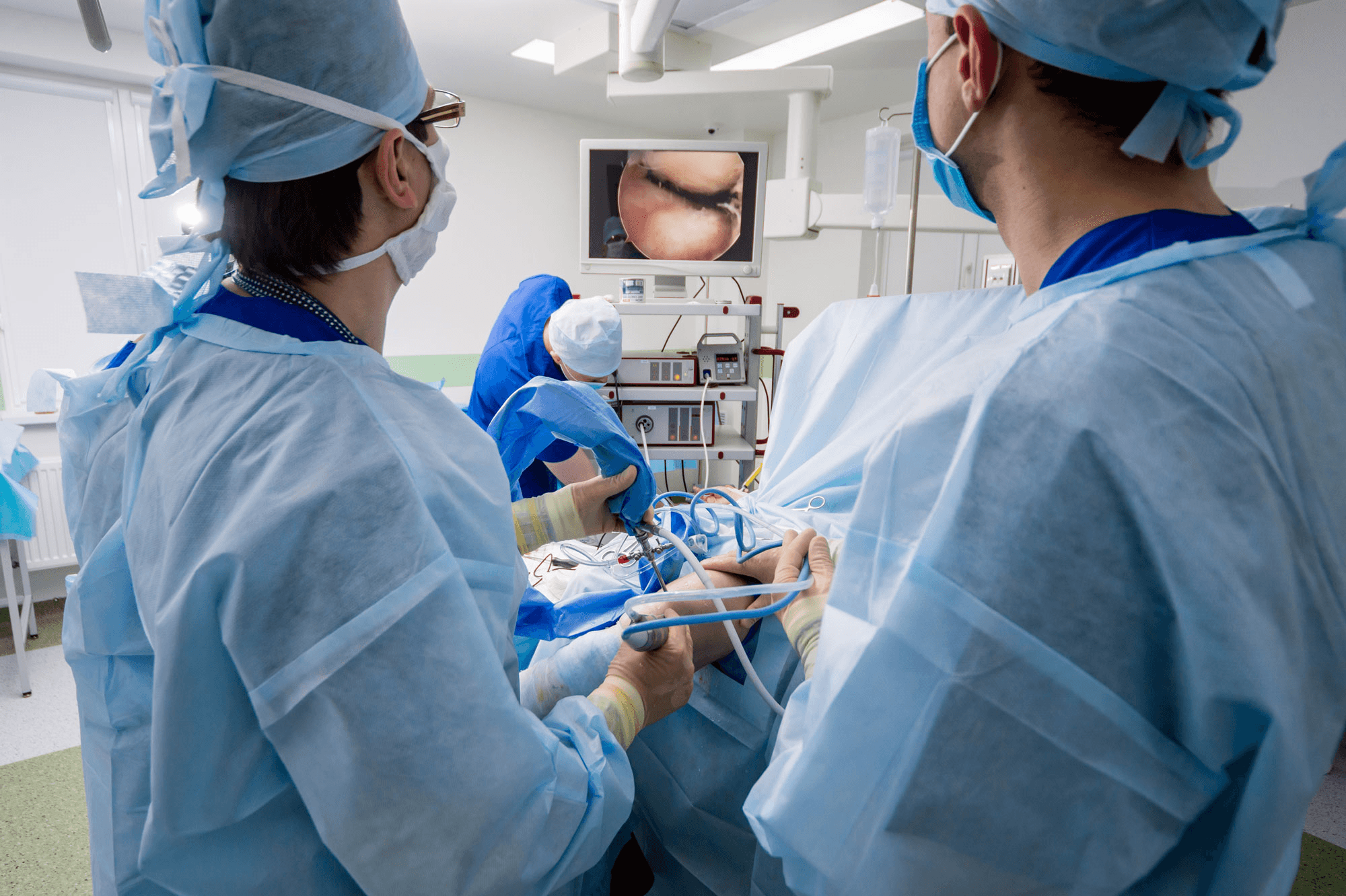
ACI, MACI, and OATS sit on the other side of that threshold entirely. All three require an operating theatre, general anaesthetic, and either arthroscopic or open joint access. ACI traditionally involves two separate surgical episodes — a biopsy harvest followed by an open implantation through a midline incision. Even the single-stage STACi variant, which brings the cell-culture step into theatre, still requires arthrotomy. MACI and OATS likewise require theatre booking, hospital admission, and formal postoperative recovery.
The divide is categorical, not a matter of degree.
Pricing reflects this structural gap. ChondroFiller injection at the London Cartilage Clinic starts from £3,000 — inclusive of consultation, ultrasound, the product itself, and a six-week follow-up. The Liquid Cartilage™ keyhole surgical pathway, by comparison, is priced at £9,800. The difference in cost is a practical signal of the difference in clinical infrastructure each option requires.
What ACI, MACI, and OATS actually involve
Surgical cartilage repair techniques are clinically legitimate procedures designed for specific presentations — understanding them accurately makes any comparison meaningful.
ACI (autologous chondrocyte implantation) works by harvesting a small cartilage biopsy — typically 200–300 mg from the femoral trochlea — culturing the extracted cells for several weeks, then reimplanting them at a second surgical visit through an open arthrotomy requiring a midline skin incision. Two separate theatre episodes under general anaesthetic are standard. Documented postoperative complications include quadriceps weakness and intra-articular adhesions. Before implantation, all damaged and sclerotic tissue must be debrided to create a stable graft bed.
MACI (matrix-induced ACI) evolved that process by embedding cultured chondrocytes within a collagen membrane, reducing handling complexity. It carries strong long-term randomised evidence — the SUMMIT trial results are examined in detail later in this article — though it remains a general-anaesthetic, arthrotomy-based procedure subject to the same preparatory requirements as classical ACI.
OATS / mosaicplasty is arthroscopic in delivery but requires harvesting osteochondral plugs from a low-load-bearing donor site within the same joint. The technique transfers intact hyaline cartilage to the defect, but creates a second area of iatrogenic damage — donor-site morbidity that can itself become a source of ongoing symptoms.
Microfracture, the most widely available arthroscopic option, penetrates the subchondral bone to provoke a marrow-clot repair response. The tissue that forms is fibrocartilage — biomechanically weaker than native hyaline cartilage — and in published series clinical outcomes typically decline after two to three years.
What unites all four approaches is that they are structurally subtractive: each requires aggressive debridement, a dry joint environment free of synovial fluid, and mechanical containment of the repair material. The structural changes made to the joint in achieving those conditions are irreversible.
Free non-medical discussion
Not sure what to do next?
Information only · No medical advice or diagnosis.
How the ChondroFiller injection works
The mechanism starts with the scaffold itself. ChondroFiller is an acellular collagen matrix — manufactured in Germany and CE-marked as a Class III medical device — delivered as a single ultrasound-guided injection in clinic, without general anaesthetic or incision.
Once injected, the scaffold gels in situ within the defect. Rather than filling the space by first removing what remains, the material is introduced into the joint in its natural fluid state and coats the damaged surface from above. Progenitor cells from the synovium and subchondral bone are then recruited into the matrix, where they can begin endogenous repair — a process described clinically as acellular matrix-induced chondrogenesis. The scaffold provides the structural framework; the body supplies the cells.
This is the practical meaning of the additive principle noted in the previous section. ACI, MACI, and OATS require the joint to be debrided, dried, and mechanically conditioned before repair material is placed; ChondroFiller injection reverses that logic by working with the joint's fluid environment rather than against it, preserving any remaining cartilage tissue throughout.
Because the scaffold is placed directly into the joint space, prophylactic IV antibiotic cover is standard practice — this is included within the single clinic appointment rather than requiring a separate hospital visit.
No irreversible structural changes are made during the injection course. That has a clinically important downstream consequence: surgical options — whether ACI, MACI, or eventually joint replacement — remain fully available if the patient's situation changes at a later stage.

Which patients suit each approach
Patient selection is where the procedural gap between injection and surgery becomes most consequential for anyone researching their options.
ACI and MACI both require a focal, contained defect with intact cartilage borders around the margins. The surrounding tissue must be healthy enough to anchor the graft and support a stable repair environment. Diffuse joint wear — degeneration that extends across multiple areas or has compromised the cartilage margins themselves — disqualifies a patient from either procedure. OATS carries a parallel constraint: the defect must be contained, and a healthy donor site must be available within the same joint; both conditions have to be met simultaneously.
ChondroFiller injection was developed for a wider population. It is documented for focal Grade III and Grade IV defects, and also for diffuse joint degeneration up to Kellgren-Lawrence Grade IV — the radiological classification that describes bone-on-bone contact. Patients who have been told surgical cartilage repair is not possible because their damage is too widespread, or their joint margins are no longer intact, may still be candidates for the injection pathway.
No upper age limit applies to ChondroFiller injection. Because the scaffold's protective and repair mechanism operates through the material itself — recruiting the patient's own progenitor cells rather than requiring the body to generate large cartilage volumes from scratch — age alone is not a disqualifying factor.
Individual suitability still depends on a full clinical assessment. Defect size, joint loading, overall joint health, and the patient's goals all bear on the decision, and no eligibility framework replaces that conversation with a specialist.
Recovery after injection vs surgery
The practical weight of this decision often comes down to recovery — what the weeks and months after a procedure actually look like.
After a ChondroFiller injection, patients leave clinic the same day. There is no general anaesthetic to recover from, no surgical wound to manage, and no dependence on theatre scheduling. Guided rehabilitation still applies, but it is proportionate to an injection pathway rather than to an operation.
Surgical routes carry a substantially heavier recovery burden. ACI and MACI both require post-operative restricted weight-bearing, typically progressing through staged physiotherapy protocols over several months before patients can return to full activity or sport. The rehabilitation is intensive by design — the graft needs time and controlled loading to integrate — and time off work is measured in weeks at minimum, often longer for physically demanding roles. OATS adds a further variable: donor-site discomfort alongside graft integration, since tissue has been harvested from within the same joint.
None of this means surgical recovery is unmanageable — surgeons guide patients through these protocols every day. The point is that two pathways impose genuinely different practical demands. For someone managing a job with no remote-work option, a young family, or a training schedule built around an upcoming event, the absence of theatre, anaesthetic, and a multi-month rehabilitation programme is not a convenience — it is a clinically relevant factor that belongs in the decision.
What outcomes data currently shows
The strongest peer-reviewed evidence in cartilage surgery belongs to MACI. The SUMMIT trial demonstrated superior KOOS pain and function scores against microfracture for defects of 3 cm² or larger at both two-year and five-year follow-up — a benchmark that gives MACI a well-documented clinical standing among the surgical options.
For ChondroFiller injection, the available outcome anchors are clinic-reported and registry-level. Published figures cite an IKDC score improvement of approximately 30 points in the knee, a modified Harris Hip Score improvement of approximately 30 points in the hip, MOCART MRI scores in the range of 70–87, and a complaint rate of approximately 0.06%. No head-to-head RCT exists comparing ChondroFiller injection directly against ACI, MACI, or OATS, and long-term durability data beyond manufacturer-published claims has not yet appeared in peer-reviewed literature. That is a genuine limitation — not a reason to dismiss the injection pathway, but a reason the two evidence bases cannot be treated as equivalent.
What the available data does allow is a directional read: MACI's five-year RCT results are the strongest published benchmark for contained surgical cases; ChondroFiller injection's clinic-reported figures suggest meaningful functional improvement in populations that would not qualify for those surgical trials at all. Where defects are diffuse, joint margins compromised, or theatre inadvisable, the injection pathway carries the better-matched evidence. Translating that into a specific recommendation depends on defect pattern, joint loading, and individual clinical history — and that is the work of a specialist assessment. ChondroFiller injection is available in the UK at the London Cartilage Clinic on Harley Street; assessments can be booked at londoncartilage.com.
- [1] Autologous chondrocyte implantation. https://en.wikipedia.org/?curid=19074150 https://en.wikipedia.org/?curid=19074150
- [2] Knee cartilage replacement therapy. https://en.wikipedia.org/?curid=4984243 https://en.wikipedia.org/?curid=4984243
Frequently Asked Questions
- Yes. It is delivered as an ultrasound-guided clinic injection without general anaesthetic or surgical incision. Patients are discharged the same day.
- ChondroFiller injection at the London Cartilage Clinic starts from £3,000, inclusive of consultation, ultrasound, product, injection, and six-week follow-up.
- It is documented for focal Grade III and IV cartilage defects, and also for diffuse joint degeneration up to Kellgren-Lawrence Grade IV, including advanced cases.
- Minimal recovery is needed. There is no general anaesthetic, surgical wound, or theatre scheduling. Guided rehabilitation is proportionate to the injection pathway.
- Yes. ChondroFiller makes no irreversible structural changes to the joint. Future surgical options including ACI, MACI, and joint replacement remain fully available.
Legal & Medical Disclaimer
This article is written by an independent contributor and reflects their own views and experience, not necessarily those of Liquid Cartilage. It is provided for general information and education only and does not constitute medical advice, diagnosis, or treatment.
Always seek personalised advice from a qualified healthcare professional before making decisions about your health. Liquid Cartilage accepts no responsibility for errors, omissions, third-party content, or any loss, damage, or injury arising from reliance on this material.
If you believe this article contains inaccurate or infringing content, please contact us at [email protected].