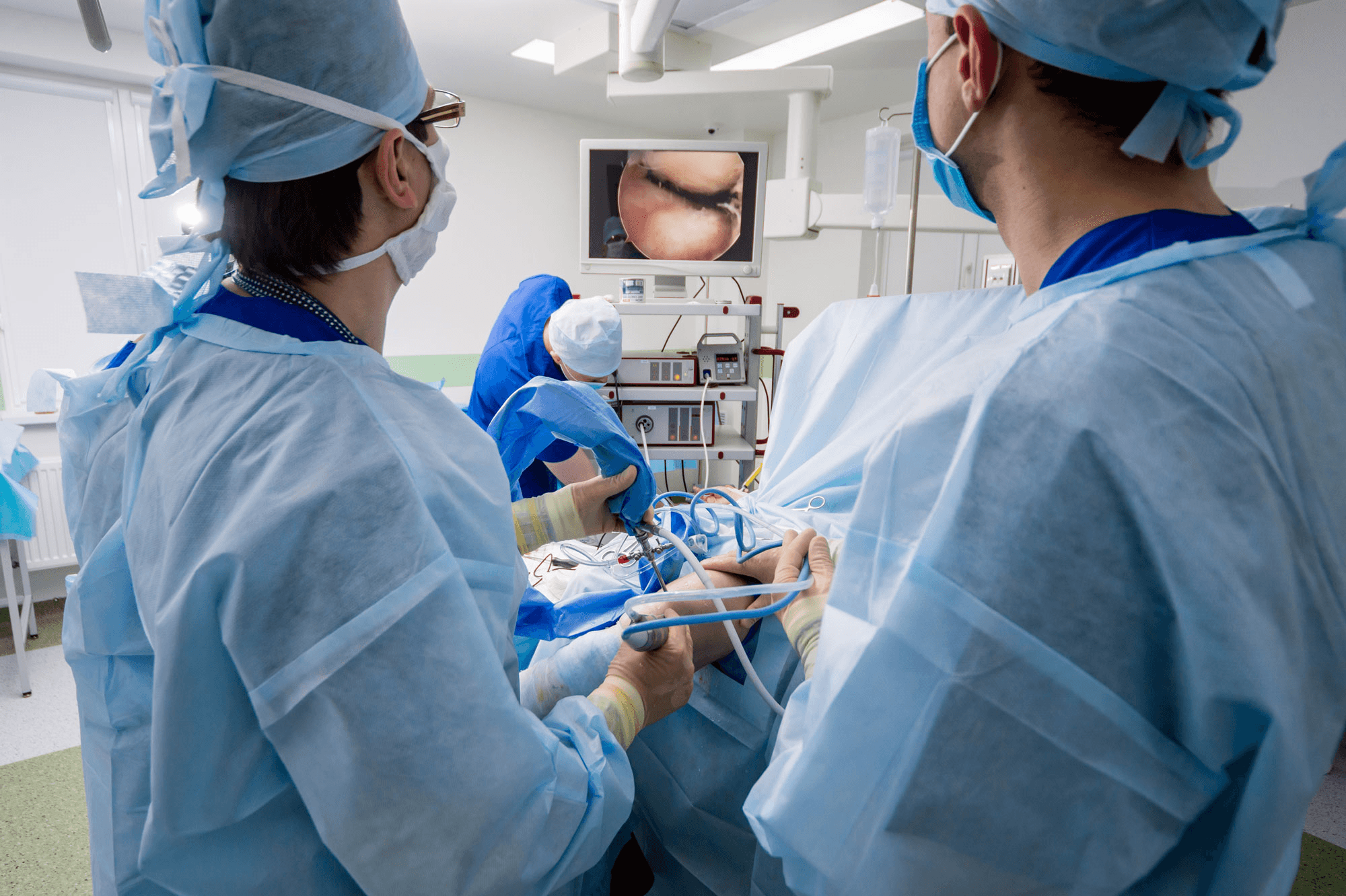

ChondroFiller injection versus MACI
Who actually qualifies for each treatment
For most people researching this comparison, the relevant question is not which treatment is better — it is which treatment is actually available to them. Eligibility determines that answer before preference gets a look-in.
NHS funding for MACI is governed by NICE Technology Appraisal TA477 (2017), and it imposes four simultaneous conditions. The patient must have a focal knee defect larger than 2 cm², must not have had any prior cartilage surgery on the same knee, must have minimal osteoarthritis, and must be referred to a specialist NHS tertiary centre. Miss any single one of those gates — a defect that measures 1.8 cm², a previous microfracture procedure, moderate OA on imaging, or the absence of a qualifying tertiary referral — and NHS-funded MACI is not an option, regardless of how otherwise suitable the patient might seem.
ChondroFiller injection operates under a different set of parameters. There is no upper age ceiling, no minimum defect size, and the treatment can be used in joints presenting with Kellgren-Lawrence Grade III or even Grade IV osteoarthritis — the range of OA severity that rules out MACI candidates immediately. Its clinical reach also extends beyond the knee: hip, ankle, and small joints are all within scope, whereas NICE currently restricts MACI to knee defects only.
One exclusion applies to both treatments equally: end-stage bone-on-bone arthritis, where the articular surfaces have been fully lost, lies outside the therapeutic window for cartilage regeneration of any kind. At that point, the clinical conversation shifts to joint replacement.
In practice, the two treatments serve largely different populations. Patients who clear every MACI criterion may be offered NHS surgery; those who fall outside that window — through age, OA grade, defect pattern, joint location, or prior intervention — are the patients for whom ChondroFiller injection becomes the primary restorative option to consider.
What each procedure actually involves
The practical gap between these two treatments becomes clear once you map out what each actually requires of the patient.
MACI: a two-stage surgical episode
MACI begins with an arthroscopic procedure under general anaesthetic to harvest a small cartilage biopsy from a low-load area of the knee. That sample is sent to a specialist laboratory, where chondrocytes are extracted, expanded, and seeded onto a porcine collagen membrane — a process that takes four to six weeks. In Stage 2, the surgeon reopens the joint, debrides the defect, and secures the cell-seeded membrane in place with fibrin glue. The entire treatment episode therefore spans at least two separate operations and several months before active rehabilitation can begin. Recovery after Stage 2 typically involves an initial period on crutches, with restricted weight-bearing as the graft integrates.
ChondroFiller injection: a single outpatient appointment
ChondroFiller injection requires no biopsy, no cell culture, and no return to theatre. The treatment is delivered as an outpatient procedure under ultrasound guidance: a two-chamber syringe of acellular Type I collagen is introduced into the prepared defect, where it self-polymerises into a stable hydrogel within three to five minutes. Over the following six to twelve months, the scaffold recruits the patient's own progenitor cells, which lay down new cartilage matrix within the gel.
One recovery consideration applies to ChondroFiller injection: a 2024 biomechanical study found that in the early post-treatment window, the scaffold has not yet reached full mechanical stability and does not immediately cushion the opposing cartilage surface. Supervised weight-bearing restrictions during this stabilisation phase are therefore a standard part of the rehabilitation protocol — a managed protocol, not an unexpected complication.
Free non-medical discussion
Not sure what to do next?
Information only · No medical advice or diagnosis.
Outcomes and complication rates compared
Published figures for both treatments show similar functional improvement at one to two years — yet the risk profiles diverge considerably, and the evidence bases are not equivalent in maturity.
Across more than 19,000 cases globally, ChondroFiller injection data show IKDC scores improving by approximately 30 points in the knee and Harris Hip Scores rising by an average of 33 points in the hip. MOCART MRI regeneration scores — which assess the quality of cartilage fill on imaging — range from 70 to 87. Published series report 70–85% of patients achieving meaningful symptom relief at three to five years, with reported complications close to zero and reoperation rates of 3–8%.
ACI and MACI literature reports broadly comparable functional gains — IKDC improvement of +30 to +35 points — but with a substantially different risk profile: complications up to 17% and reoperation rates reaching 37% in some series. That gap partly reflects the fundamental difference in what each procedure involves. Adverse events after open or arthroscopic cartilage surgery — wound problems, graft delamination, joint stiffness, deep infection — have no direct equivalent in an outpatient ultrasound-guided injection. The figures provide useful context, but the two datasets are not counting complications from equivalent clinical events, and readers should weigh them accordingly.
MACI's standing in cartilage repair is grounded in regulatory approval and evidence maturity rather than demonstrated superiority over alternatives. A 2025 matched-pair study of 48 patients found no statistically significant differences between MACI, AMIC, and arthroscopic minced cartilage on VAS pain, KOOS-Pain, KOOS-Symptoms, KOOS-ADL, or KOOS-QOL at two-year follow-up; all three groups improved significantly from baseline. That result does not suggest MACI is inferior — only that its pre-eminence is not yet proven against newer techniques.
Two evidence gaps matter for long-term planning. No published head-to-head randomised trial directly compares ChondroFiller injection against MACI — the outcome figures above come from separate datasets with different patient populations. And where MACI's evidence base extends to ten years in some series, ChondroFiller injection's published follow-up reaches five years in limited cohorts. For patients making decisions about a joint they expect to use for decades, that asymmetry is a genuine consideration.

How repair tissue forms in each approach
Behind each procedure is a different biological strategy for the same goal: producing repair tissue that resembles native hyaline cartilage — rich in Type II collagen — rather than the fibrocartilage that forms after older techniques such as microfracture. Fibrocartilage is structurally weaker and breaks down more readily under load; the durability case for both MACI and ChondroFiller injection rests on their capacity to produce something closer to the original tissue.
MACI achieves this through cells already loaded onto the membrane. The chondrocytes seeded during the laboratory phase are committed to producing cartilage matrix; once the implant is secured in the defect, they begin laying down the collagen and proteoglycan architecture of new cartilage from within the scaffold.
ChondroFiller injection works differently. The scaffold contains no cells of its own. After injection and in-situ gelation, it recruits repair cells — progenitor cells from the surrounding tissue and synovial fluid — into the scaffold matrix. An ex vivo osteochondral model confirmed a 2.4-fold increase in DNA content within ChondroFiller-treated explants by day 14, consistent with active cell migration into the gel rather than passive filling of the defect.
Placement precision is clinically meaningful. A 2025 controlled study of wrist cartilage defects found that applications placed flush with the native cartilage surface produced Outerbridge grade 1 repair tissue; overfilled defects formed fibrous tissue instead. That finding reflects a broader principle: the scaffold can perform differently depending on how accurately it is placed, which makes experienced, image-guided delivery a genuine part of the treatment outcome — not a procedural formality.
Cost, NHS access, and how to get treatment in London
The financial picture breaks cleanly along the eligibility lines covered in the first section.
MACI carries NHS funding under NICE TA477 (2017) for patients who meet the qualification criteria already described. Private MACI is structurally uncommon: the two-stage process — specialist theatre, laboratory cell culture over four to six weeks, and tertiary-centre coordination — is difficult to replicate outside an NHS setting, and very few providers offer it privately.
ChondroFiller injection sits outside NHS and private insurer coverage entirely. Bupa and AXA do not reimburse it. At the London Cartilage Clinic — the UK's certified delivery centre for the product — self-funded pricing runs from £3,000 for a single-box treatment to £5,500 for two boxes and £8,000 for three, inclusive of consultation, ultrasound guidance, the product, and a six-week follow-up appointment. For patients who do qualify for MACI, the practical comparison is therefore NHS-delivered surgery at no direct cost against an out-of-pocket injection.
Neither pathway requires a financial commitment before a clinical assessment. An initial appointment at the London Cartilage Clinic on Harley Street establishes which route is realistic for a given patient — including whether they meet the MACI threshold or fall outside it — before any cost decision arises.
Making the decision: questions to ask at your assessment
The clinical assessment does one thing above all else: it places a patient in one of two groups — those for whom MACI is a realistic NHS pathway, and those for whom it is not. Once that is established, most questions resolve themselves. A handful, however, are worth raising explicitly because the published evidence alone does not answer them.
If MACI appears to be in scope, ask for this centre's reoperation rate — not the published literature average. As noted earlier, reported reoperation figures for ACI and MACI reach as high as 37% across studies; individual centre volume and surgical experience carry real weight. Also ask what the wait time is between biopsy and implantation, whether a change in your OA grade during that window would affect second-stage eligibility, and what the contingency is if the implant does not integrate.
If you fall outside the MACI window, the questions shift. How many units of ChondroFiller injection are needed for the defect size confirmed on imaging, and what does that mean for cost? What are the weight-bearing restrictions during the first six to eight weeks, and how will those fit your work or commute? How does this treatment interact with any prior marrow-stimulation procedure on the same joint — does it affect scaffold integration?
For both groups, one question applies regardless of which route is taken: where does joint replacement sit on the timeline if restorative treatment is only partially successful? The answer shapes what 'a good outcome' realistically means, and it is a conversation worth having before committing to either pathway.
Liquid Cartilage™ is delivered in the UK at the London Cartilage Clinic on Harley Street — book an initial assessment at londoncartilage.com.
- [1] Influence of cartilage defects and a collagen gel on integrity of corresponding intact cartilage: a biomechanical in-vitro study. (2024). https://doi.org/10.1007/s00402-024-05530-z https://doi.org/10.1007/s00402-024-05530-z
- [2] Cartilage reconstruction using Chondrofiller in intra-articular distal radius fractures. (2025). https://doi.org/10.1186/s42836-025-00333-y https://doi.org/10.1186/s42836-025-00333-y
- [3] Development of an Ex Vivo Osteochondral Biomimetic Platform for Mechanistic Investigation of Cartilage Regeneration. (2025). https://doi.org/10.3390/ijms262311759 https://doi.org/10.3390/ijms262311759
Frequently Asked Questions
- Patients must meet all four criteria: focal knee defect larger than 2 cm², no prior cartilage surgery on that knee, minimal osteoarthritis, and referral to an NHS tertiary centre. Missing any single criterion disqualifies them.
- MACI is two-stage surgery under general anaesthetic: cartilage biopsy harvest, laboratory cell culture over four to six weeks, then implantation. ChondroFiller is single outpatient ultrasound-guided injection that self-polymerises within minutes.
- Pricing ranges from £3,000 for single-box treatment to £8,000 for three boxes, inclusive of consultation, ultrasound guidance, product, and six-week follow-up. Costs vary based on defect size requiring multiple units.
- MACI is currently restricted to knee defects by NICE. ChondroFiller has no anatomical limitation and is used in knee, hip, ankle, and small joints including wrist and foot.
- ChondroFiller shows complications close to zero with reoperation rates of three to eight per cent. MACI literature reports complications reaching seventeen per cent and reoperation rates as high as thirty-seven per cent.
Legal & Medical Disclaimer
This article is written by an independent contributor and reflects their own views and experience, not necessarily those of Liquid Cartilage. It is provided for general information and education only and does not constitute medical advice, diagnosis, or treatment.
Always seek personalised advice from a qualified healthcare professional before making decisions about your health. Liquid Cartilage accepts no responsibility for errors, omissions, third-party content, or any loss, damage, or injury arising from reliance on this material.
If you believe this article contains inaccurate or infringing content, please contact us at [email protected].