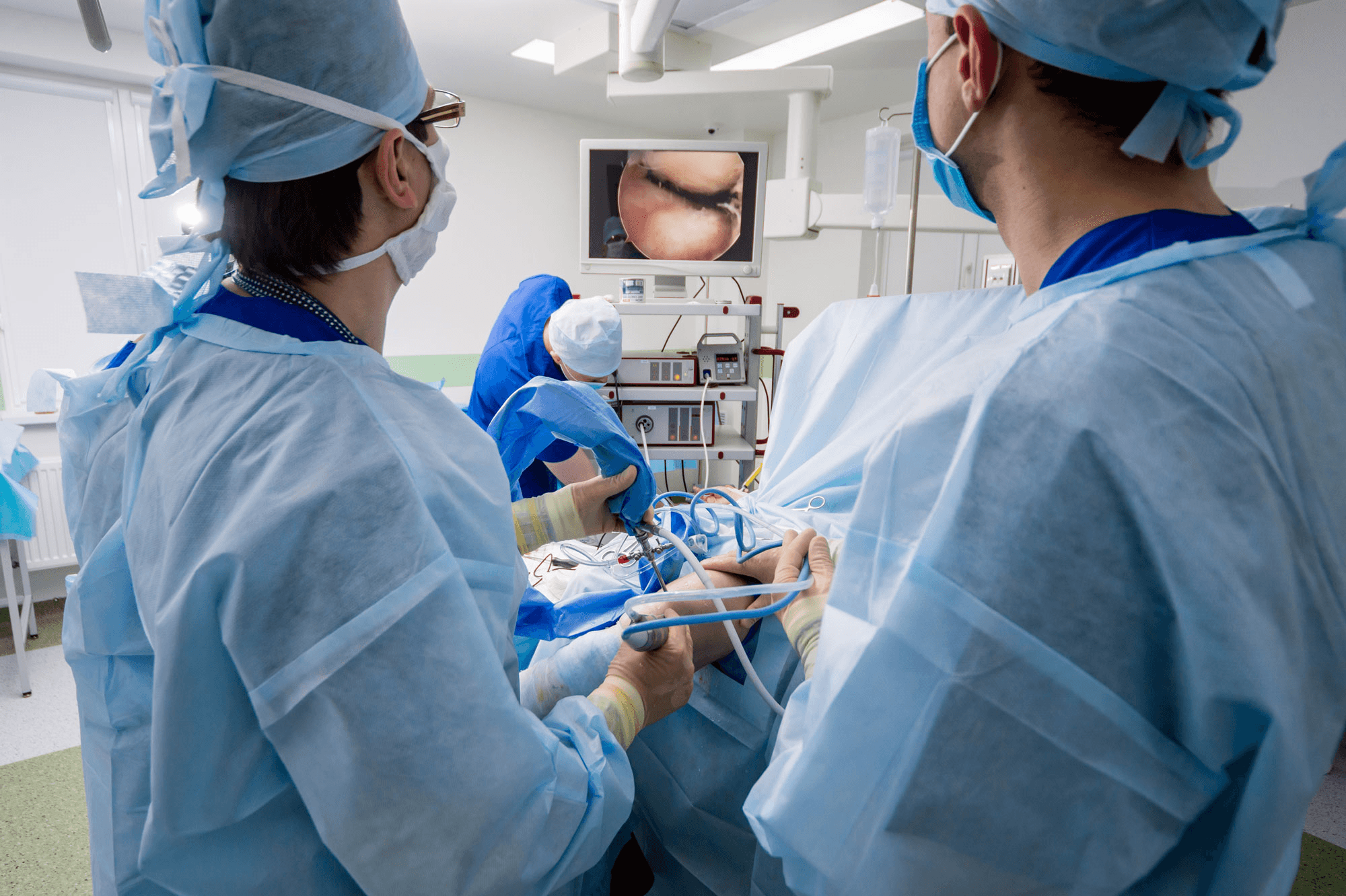

ChondroFiller injection for shoulder cartilage repair
Is a shoulder cartilage defect suitable for ChondroFiller injection?
Most shoulder cartilage injuries that reach specialist investigation fall into one of two broad categories: a defined focal defect — a patch of damaged or missing cartilage — or more diffuse degeneration affecting the joint surface as a whole. ChondroFiller injection is suited to the first.
If your MRI shows a focal chondral lesion in the glenohumeral joint, typically up to around 3 cm² (and in some cases extendable to 6 cm²), with surrounding cartilage and underlying bone broadly intact, you may be a suitable candidate. The clearest indication is a bounded lesion arising from trauma, repetitive loading, or early localised degeneration — not a joint where most of the articular surface has already broken down.
Where significant osteoarthritis is already established across the joint, ChondroFiller injection is unlikely to deliver meaningful benefit. Hip arthroscopy data — the closest published ball-and-socket proxy available — found that patients with pre-existing advanced OA (Tönnis grade 2–3) achieved consistently poor outcomes, underscoring that the scaffold requires a reasonably healthy joint environment to be effective.
The treatment is delivered as an ultrasound-guided outpatient injection rather than a surgical procedure. A clinical assessment at the London Cartilage Clinic on Harley Street establishes lesion grade, defect size, and overall joint condition before any decision is made — including how the distinctive anatomy of the glenohumeral joint bears on whether and how the treatment is applied.
What makes the glenohumeral joint different from the knee or hip
Unlike the hip, which is deepened and stabilised by a substantial bony socket, the glenohumeral joint achieves its extraordinary range of motion precisely because the glenoid fossa is shallow — a golf ball resting on a tee is the standard analogy. That looseness is what allows the arm to rotate freely in almost any direction, but it also means a deposited scaffold faces multi-directional mechanical forces that are harder to predict than those acting on the knee or even the hip socket.
Shoulder articular cartilage also looks different under the microscope. Compared with knee or ankle cartilage of equivalent grade, glenohumeral cartilage shows reduced Safranin O staining — a histological marker that reflects how proteoglycans are arranged in the tissue matrix. In practical terms, think of it as the cartilage having a subtly different internal architecture. Crucially, the underlying cell biology remains intact: proteoglycan synthesis and the genes that drive cartilage formation — including collagen II and aggrecan — are comparable across joints. The shoulder cartilage is structurally distinctive, but it retains the biological machinery that a regenerative scaffold needs to recruit and support new tissue.
For patients with focal glenohumeral lesions arising from instability episodes, SLAP tears, or post-traumatic damage, the current surgical options — microfracture and chondrocyte implantation — produce short-term pain relief but uncertain long-term durability. In one systematic review, 22 of 32 patients who required a second procedure ultimately progressed to joint replacement. The case for a minimally invasive, joint-preserving approach at an earlier stage is clear.
Free non-medical discussion
Not sure what to do next?
Information only · No medical advice or diagnosis.
How the collagen scaffold recruits the body's own repair cells
The regenerative work does not come from the product itself — it comes from the patient's own biology. ChondroFiller is an acellular Type I collagen hydrogel: it carries no donor cells and no growth factors are added. Think of it as creating the right environment and letting the body supply the workforce.
Once the gel is injected under ultrasound guidance, it polymerises in situ — setting within the defect to form a three-dimensional collagen scaffold. That scaffold acts as a chemotactic signal: it attracts the patient's own stem cells and chondrocyte precursors into the damaged area, giving them a structured matrix to populate and build upon. An ex vivo osteochondral model confirmed this process directly, recording a 2.4-fold increase in DNA content within the scaffold by day 14, with a significant correlation between cell invasion and new collagen deposition — evidence that the host's cells are driving genuine matrix synthesis rather than simply filling space.
At the same time, the scaffold serves a second, protective function. Before new tissue has had the chance to consolidate, the gel acts as a mechanical cushion over the damaged cartilage surface, absorbing load and shielding the area while regeneration proceeds from below. These two roles — chemotactic scaffold and protective cover — are inseparable parts of the same material.
The timeline visible on MRI reflects both functions unfolding sequentially. Studies tracking knee cartilage defects treated with ChondroFiller show progressive maturation of the repair tissue from 6 to 52 weeks, with newly formed cartilage integrating flush with the surrounding native surface over time. Patients should expect a gradual biological process rather than an immediate structural fix.

Scaffold retention in the shoulder's high-mobility environment
Deploying a gelling scaffold in the most mobile joint in the human body raises a practical question: can the material hold its position long enough to polymerise and do its work?
ChondroFiller's combination of high viscosity and rapid in-situ polymerisation is specifically what allows it to be injected into a fluid joint environment — no surgical dry-field preparation is needed. The gel sets quickly enough to resist early displacement. Under ultrasound guidance, the clinician can confirm in real time that the scaffold has been deposited at the correct depth and distribution across the defect; in a joint with less bony containment than the hip or knee, that live visual confirmation is a direct quality check on placement accuracy, not simply a technical formality.
There is, however, a documented early-loading limitation. In-vitro testing has shown that before polymerisation is complete, the scaffold provides limited mechanical protection against opposing cartilage under cyclic loading. This is a consideration rather than a barrier, and it is precisely why a structured post-injection rest period is clinically important. Minimising shoulder movement in the immediate hours after treatment gives the collagen matrix time to stabilise before the joint returns to its full arc of motion.
At the London Cartilage Clinic, the post-injection loading plan — including how much movement is appropriate and over what timeframe — is discussed during the assessment consultation and tailored to the defect size and location. Because the same scaffold material can behave differently depending on the precision of image-guided placement, specialist delivery experience in the shoulder is a meaningful variable in achieving consistent outcomes.
What the clinical evidence shows — and where the gaps are
No published clinical data yet specifically address ChondroFiller injection in the glenohumeral joint — that gap should be named clearly rather than papered over.
The most relevant available evidence comes from the hip. Both joints share the same synovial ball-and-socket architecture, making hip outcomes the closest structural proxy in the published literature. In a cohort of 26 patients with acetabular cartilage lesions greater than 2 cm², 17 of 21 evaluable participants achieved good or excellent results at three to five years of follow-up. Patient selection proved decisive: those with pre-existing advanced osteoarthritis (Tönnis grade 2–3) fared poorly, while those with focal defects in otherwise healthy joints drove the positive results. The practical implication is consistent with the shoulder: the therapy is suited to contained, focal lesions — not joints already showing widespread degeneration.
Data from other joints adds further context. Knee studies show an approximately 30-point IKDC improvement at one year, with MRI confirming progressive maturation of repair tissue over 6 to 52 weeks. In wrist cartilage lesions treated arthroscopically, Outerbridge grade improved from a median of 3.0 to 1.5 (p = 0.006) versus untreated controls — a structurally meaningful difference in a compact, load-bearing joint.
For the shoulder specifically, early feasibility work on scaffold-based approaches is encouraging, if not ChondroFiller-specific. A small series using micronized allogenic cartilage scaffold for posterior glenoid defects reported improvements in subjective shoulder value from 40 to 85 and VAS pain scores from 4 to 1 at a mean of 2.6 years — evidence that the glenohumeral environment can support scaffold-based repair. Taking the hip data as the nearest anatomical analogue, where four in five focal-defect patients achieved good or excellent results over three to five years, offers a reasonable — if provisional — frame of reference for shoulder patients considering ChondroFiller injection while shoulder-specific series are still being established.
Getting assessed at the London Cartilage Clinic
The question most patients bring to this page — whether their shoulder damage is focal enough, and their joint healthy enough, for a scaffold approach — is ultimately answered by MRI and clinical assessment rather than self-diagnosis. Even so, the pattern across the available evidence is consistent: focal cartilage lesions in joints without widespread degeneration represent the appropriate indication, while diffuse osteoarthritis sits clearly outside it. That distinction, not the product alone, is what determines whether a ChondroFiller injection is likely to offer meaningful benefit.
At the London Cartilage Clinic on Harley Street, an initial assessment reviews existing imaging, lesion characteristics, symptom history, and overall joint health to establish whether the defect profile is suitable for image-guided scaffold placement. Professor Paul Y. F. Lee, who leads clinical delivery of Liquid Cartilage™ in the UK, can also advise where an alternative joint-preservation pathway may be more appropriate — a decision that requires individual clinical judgement, not an off-the-shelf answer.
The London Cartilage Clinic is the UK's certified delivery centre for Liquid Cartilage™ (ChondroFiller). Patients from across London and the commuter belt typically attend for a single assessment before any treatment decision is made. Appointments and further information are available at londoncartilage.com.
- [1] Surgical treatment options for articular cartilage defects of the glenohumeral joint: A systematic review. (2022). https://doi.org/10.1177/17585732221142610 https://doi.org/10.1177/17585732221142610
- [2] Influence of cartilage defects and a collagen gel on integrity of corresponding intact cartilage: a biomechanical in-vitro study. (2024). https://doi.org/10.1007/s00402-024-05530-z https://doi.org/10.1007/s00402-024-05530-z
- [3] Shoulder joint. https://en.wikipedia.org/?curid=2974848 https://en.wikipedia.org/?curid=2974848
- [4] Arthroscopic utilization of ChondroFiller gel for the treatment of hip articular cartilage defects: a cohort study with 12- to 60-month follow-up. (2021). https://doi.org/10.1093/jhps/hnab002 https://doi.org/10.1093/jhps/hnab002
- [5] Controlled, randomized multicenter study to compare compatibility and safety of ChondroFiller liquid with microfracturing of patients with focal cartilage defects of the knee joint. (2016). https://doi.org/10.5348/VNP05-2016-1-OA-1 https://doi.org/10.5348/VNP05-2016-1-OA-1
- [6] Cartilage reconstruction using Chondrofiller in intra-articular distal radius fractures. (2025). https://doi.org/10.1186/s42836-025-00333-y https://doi.org/10.1186/s42836-025-00333-y
- [7] Implantation of ChondroFiller Liquid® as a Scaffold Material for the Treatment of Chondral Lesions of the Knee Joint. (2024). https://doi.org/10.5272/jimab.2024304.5936 https://doi.org/10.5272/jimab.2024304.5936
- [8] Development of an Ex Vivo Osteochondral Biomimetic Platform for Mechanistic Investigation of Cartilage Regeneration. (2025). https://doi.org/10.3390/ijms262311759 https://doi.org/10.3390/ijms262311759
- [9] Biologic Characteristics of Shoulder Articular Cartilage in Comparison to Knee and Ankle Articular Cartilage From Individual Donors. (2019). https://doi.org/10.1177/1947603519847740 https://doi.org/10.1177/1947603519847740
Frequently Asked Questions
- Patients with focal cartilage lesions, typically up to 3 cm² (sometimes 6 cm²), in otherwise healthy joints. Advanced osteoarthritis and diffuse degeneration are unsuitable. MRI assessment determines candidacy.
- The shallow glenohumeral socket allows extraordinary mobility but creates unpredictable multi-directional forces on injected material. Ultrasound guidance confirms placement accuracy, directly checking quality in this less-contained environment.
- ChondroFiller is an acellular collagen scaffold. It acts chemotactically, attracting the patient's own stem cells and chondrocytes into the defect whilst providing mechanical protection during regeneration.
- No published data yet exists specifically for shoulder ChondroFiller injection. Hip data is the closest proxy, showing four in five focal-defect patients achieved good or excellent results over three to five years.
- Before polymerisation completes, the scaffold offers limited mechanical protection. A structured rest period is important, minimising shoulder movement whilst the collagen matrix stabilises before full mobility resumes.
Legal & Medical Disclaimer
This article is written by an independent contributor and reflects their own views and experience, not necessarily those of Liquid Cartilage. It is provided for general information and education only and does not constitute medical advice, diagnosis, or treatment.
Always seek personalised advice from a qualified healthcare professional before making decisions about your health. Liquid Cartilage accepts no responsibility for errors, omissions, third-party content, or any loss, damage, or injury arising from reliance on this material.
If you believe this article contains inaccurate or infringing content, please contact us at [email protected].