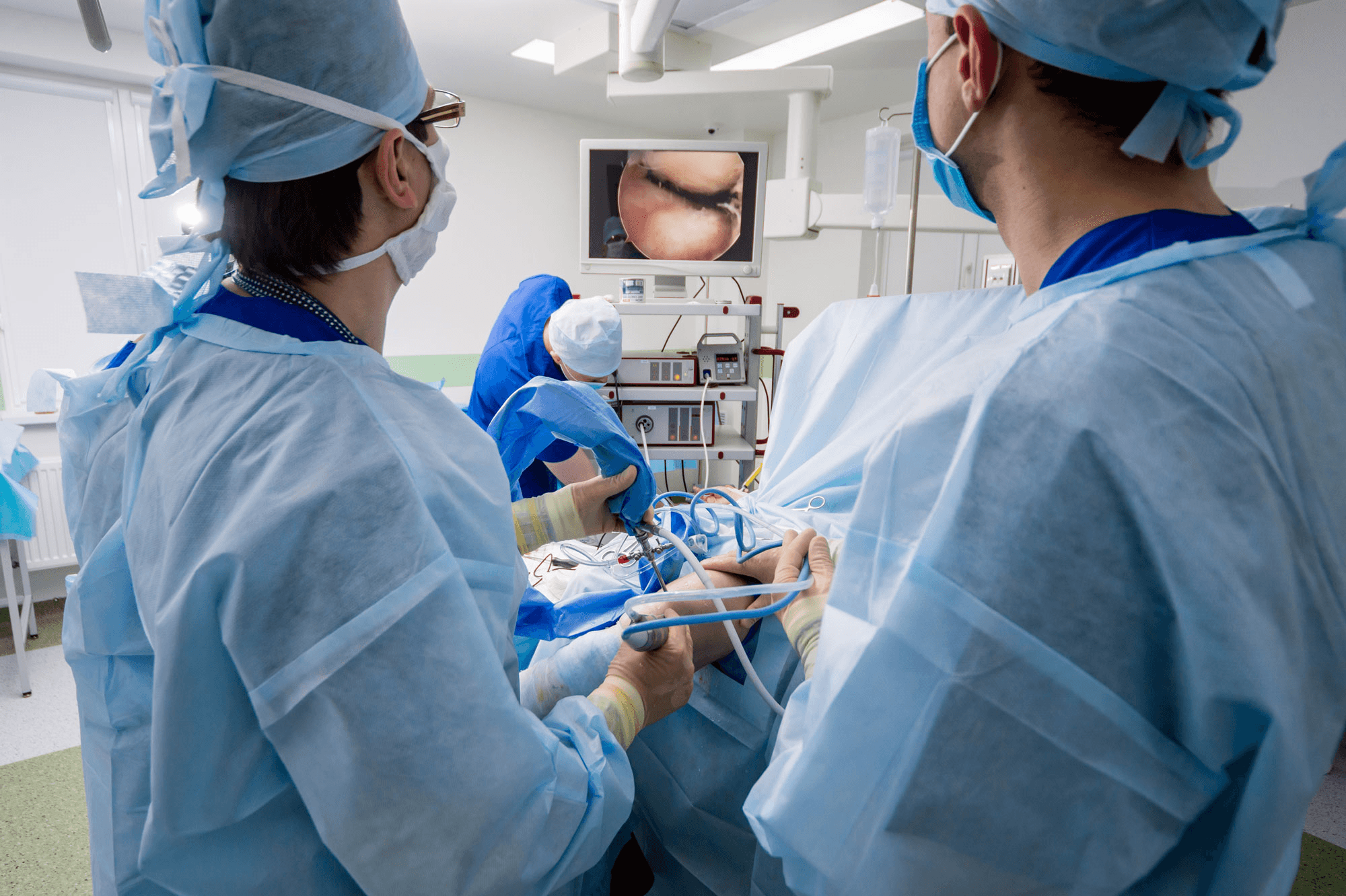

ChondroFiller injection for hip cartilage defects
Which hip cartilage problems are suitable for ChondroFiller injection
Most patients searching for hip cartilage treatment arrive with the same underlying question: is my damage the right kind for this? For ChondroFiller injection, the answer turns on one distinction — focal versus diffuse.
Focal damage means a defined, contained area of cartilage loss on a joint surface that otherwise retains its structure. ChondroFiller injection is designed for exactly this: isolated Grade III or IV chondral defects on the acetabulum, typically lesions larger than 2 cm², where the cartilage immediately surrounding the damage is still healthy and can serve as a border for the scaffold to fill against. Femoroacetabular impingement (FAI) accompanied by this type of acetabular lesion is the archetypal scenario — the pattern studied in a 26-patient prospective cohort that tracked outcomes over three to five years, confirming good or excellent results in 17 of 21 evaluable patients.
Diffuse damage tells a different story. When arthritis has spread across a wider portion of the joint — what clinicians grade using the Tönnis scale, a measure of how much background wear the hip already shows — ChondroFiller injection is not appropriate. Patients with Tönnis Grade 2 or 3 changes fared poorly in the same cohort, establishing advanced background osteoarthritis as a clear disqualifying finding. Bipolar disease, where both the femoral head and acetabulum are affected, falls outside the scope of this treatment for the same reason.
If the defect is isolated, the surrounding cartilage is intact, and there is no significant background arthritis, ChondroFiller injection is a conversation worth having at assessment.
How the collagen scaffold repairs cartilage from the inside
Injected as a liquid, ChondroFiller becomes something quite different once it reaches the joint. The gel is a two-component Type I collagen hydrogel — the same structural protein found in native cartilage — that polymerises in situ within seconds of delivery, forming a three-dimensional scaffold that conforms to the shape of the defect. Think of it as a precisely placed biological framework that fills the damaged area and holds its position without any mechanical fixation.
Critically, the product contains no donor cells of any kind. There is no biopsy, no laboratory cell culture, and no theatre procedure. Instead, the scaffold works by recruitment: its collagen matrix creates the right physical and chemical environment for the patient's own mesenchymal progenitor cells — naturally present in the joint fluid and surrounding tissue — to migrate in and begin laying down new cartilage-like material. An ex vivo osteochondral explant study reported a 2.4-fold increase in DNA content within ChondroFiller-treated defects by day 14, indicating substantial cell ingrowth. That is supportive evidence of the recruitment mechanism, not a guarantee of outcome in any individual patient.
Over subsequent months, this process of matrix-induced chondrogenesis gradually replaces the scaffold with regenerating tissue, which can be monitored on follow-up MRI. Because the injection is additive rather than preparatory — it does not require the joint surface to be debrided or dried beforehand — it can be delivered as an ultrasound-guided outpatient procedure. That design choice is what separates it from two-stage cell-based approaches such as ACI or MACI, which require a surgical biopsy and laboratory culture before any repair material can be placed.
Free non-medical discussion
Not sure what to do next?
Information only · No medical advice or diagnosis.
What the ultrasound-guided injection involves
The appointment takes place in an outpatient clinic — no general anaesthetic, no operating theatre, no overnight stay. Under local anaesthesia, the hip is accessed with a fine needle guided in real time by ultrasound, allowing the clinician to confirm accurate placement within the joint before any material is delivered. Published data from femoroacetabular impingement literature report 91.7% accuracy for confirming intra-articular position with this technique, with no injection complications recorded across the studied cohort.
Once the needle tip is correctly positioned, the two-component collagen gel is injected directly into the defect. The scaffold polymerises within the joint's natural fluid environment; the formulation is designed to gel in situ, so the wet conditions inside the hip do not prevent it from setting — no preparation of the joint surface beforehand is required.
Fill precision has measurable consequences. A study comparing outcomes by application technique found that flush, level filling produced significantly better cartilage quality grades at follow-up — median Outerbridge score 1.5 versus 3.0 (p=0.006) — while overfilled defects developed fibrous tissue. Because the quality of the result is so directly tied to how the injection is applied, clinical experience in image-guided hip delivery matters. Professor Paul Y. F. Lee leads ChondroFiller injection at the London Cartilage Clinic on Harley Street; where a procedure is this technique-sensitive, that depth of practice is a relevant part of the treatment decision.

What the outcome data shows — MRI healing and functional scores
MRI follow-up in that 2021 cohort confirmed cartilage healing across the group — the same patients whose good and excellent results at three-to-five years were covered in the earlier section. Importantly, no adverse events were attributed to the implant across all 26 participants, a meaningful signal given that the hip joint is both load-bearing and technically demanding to access.
What those results mean functionally is best understood through the modified Harris Hip Score (mHHS), the standard patient-reported outcome measure for hip cartilage procedures. Scored from 0 to 100, it captures pain intensity, range of movement, daily activity tolerance, and the ability to manage ordinary tasks — the measures most patients actually care about. Cross-study data in hip chondral repair suggest that 73–89% of patients undergoing cartilage restoration reach the mHHS minimal clinically important difference (MCID): the threshold below which a numerical change is unlikely to feel meaningful day-to-day.
The 2021 hip study reported MRI healing endpoints rather than patient-reported scores, so direct mHHS trajectory data for ChondroFiller injection in the hip are not yet published. That gap is partly addressed by knee cohort evidence, where IKDC scores — a functionally comparable instrument — improved significantly at three and six months and stabilised by twelve months. The hip study did not collect equivalent score data, so applying this trajectory to hip outcomes is a reasonable clinical inference rather than a confirmed finding; it is cited here to give patients a working sense of when improvement is typically felt, not as a direct ChondroFiller hip result.
Post-treatment imaging uses the MERCH system: a seven-domain MRI framework assessing defect fill volume, tissue integration, surface quality, subchondral changes, and delamination, validated by Delphi consensus and requiring a minimum 12-month window on 3.0T MRI. In practical terms, the first scan that can reliably show whether the scaffold has matured into repair tissue comes roughly a year after the injection — which coincides with the period when functional scores in comparable cohorts also tend to plateau.
Recovery, loading restrictions, and who this will not help
Recovery after a ChondroFiller injection is not immediate, and planning around that reality matters.
The reason is biomechanical. A laboratory loading study confirmed that the collagen scaffold is initially unstable under cyclic compression — meaning it cannot yet withstand the repetitive forces of normal weight-bearing. Full loading must therefore be restricted until imaging confirms that the defect has achieved stable fill. Practically, this means a phased return to activity: walking aids in the early weeks, graduated increases in load as the scaffold matures, and a cautious approach to impact exercise until the 12-month MRI assessment. Patients who need to be on their feet for work, or who travel frequently, should factor this window into their planning.
On suitability: the key selection criteria were set out earlier. To summarise briefly for patients who have skipped ahead — if a consultant has noted Tönnis Grade 2–3 osteoarthritis, or widespread cartilage loss rather than a contained defect, ChondroFiller injection is unlikely to be appropriate. The 2021 hip cohort showed this group fared poorly, and those findings represent a firm clinical boundary.
Patients who fall outside the indication are not without options. A joint-preservation assessment — which may include alignment correction, biologic support, or a discussion of hip resurfacing — is the appropriate next conversation, and the London Cartilage Clinic offers that pathway evaluation as part of a full hip consultation.
Getting assessed at the London Cartilage Clinic
For patients whose imaging points to a focal, contained defect with intact surrounding cartilage — the profile this article has described throughout — the question it opened with has a clearer answer than it does for most regenerative options: the selection criteria are well-defined, the delivery is outpatient, and the clinical evidence exists specifically in the hip. That combination is relatively unusual in cartilage repair, where much of the data comes from the knee.
An assessment at the London Cartilage Clinic on Harley Street is the practical next step. A consultant will review your MRI and, where relevant, X-ray, confirm defect grade and size, and rule out advanced osteoarthritis — the factors that determine whether ChondroFiller injection is genuinely appropriate for you, rather than for the group of patients in the published cohort. No commitment to treatment is expected from that appointment. Bookings can be made at londoncartilage.com.
- [1] Arthroscopic utilization of ChondroFiller gel for the treatment of hip articular cartilage defects: a cohort study with 12- to 60-month follow-up. (2021). https://doi.org/10.1093/jhps/hnab002 https://doi.org/10.1093/jhps/hnab002
- [2] Defining hip cartilage repair: a modified delphi study to establish the MERCH score. (2023). https://doi.org/10.1186/s40634-023-00676-y https://doi.org/10.1186/s40634-023-00676-y
- [3] Rates of Achieving Meaningful Outcomes 2-Year After Microfracture Augmented with Allograft Cartilage and Autologous PRP For Hip Chondral Defects. (2025). https://doi.org/10.1093/jhps/hnaf011.072 https://doi.org/10.1093/jhps/hnaf011.072
- [4] Ultrasound and ultrasound-guided hip injection have high accuracy in the diagnosis of femoroacetabular impingement with atypical symptoms. (2020). https://doi.org/10.1016/j.arthro.2020.08.013 https://doi.org/10.1016/j.arthro.2020.08.013
- [5] Cartilage reconstruction using Chondrofiller in intra-articular distal radius fractures. (2025). https://doi.org/10.1186/s42836-025-00333-y https://doi.org/10.1186/s42836-025-00333-y
- [6] Influence of cartilage defects and a collagen gel on integrity of corresponding intact cartilage: a biomechanical in-vitro study. (2024). https://doi.org/10.1007/s00402-024-05530-z https://doi.org/10.1007/s00402-024-05530-z
- [7] IMPLANTATION OF CHONDROFILLER LIQUID® AS A SCAFFOLD MATERIAL FOR THE TREATMENT OF CHONDRAL LESIONS OF THE KNEE JOINT. (2024). https://doi.org/10.5272/jimab.2024304.5936 https://doi.org/10.5272/jimab.2024304.5936
- [8] Development of an Ex Vivo Osteochondral Biomimetic Platform for Mechanistic Investigation of Cartilage Regeneration. (2025). https://doi.org/10.3390/ijms262311759 https://doi.org/10.3390/ijms262311759
- [9] Controlled, randomized multicenter study to compare compatibility and safety of ChondroFiller liquid with microfracturing of patients with focal cartilage defects of the knee joint. (2016). https://doi.org/10.5348/VNP05-2016-1-OA-1 https://doi.org/10.5348/VNP05-2016-1-OA-1
Frequently Asked Questions
- Focal, contained defects (Grade III–IV) larger than 2 cm² where surrounding cartilage remains healthy. Not suitable for widespread damage or advanced osteoarthritis (Tönnis Grade 2–3).
- The injectable gel polymerises in situ, forming a three-dimensional framework that recruits the patient's own mesenchymal cells to lay down new cartilage-like tissue over subsequent months.
- No. It is an outpatient procedure under local anaesthesia, guided by ultrasound in real time. No operating theatre or overnight stay required.
- Recovery is phased. Walking aids are used early on, with graduated loading as the scaffold matures. Impact exercise is restricted until the 12-month MRI assessment confirms healing.
- A 26-patient prospective cohort tracked over three to five years showed good or excellent results in 17 of 21 evaluable patients, with MRI-confirmed healing and no implant-related adverse events.
Legal & Medical Disclaimer
This article is written by an independent contributor and reflects their own views and experience, not necessarily those of Liquid Cartilage. It is provided for general information and education only and does not constitute medical advice, diagnosis, or treatment.
Always seek personalised advice from a qualified healthcare professional before making decisions about your health. Liquid Cartilage accepts no responsibility for errors, omissions, third-party content, or any loss, damage, or injury arising from reliance on this material.
If you believe this article contains inaccurate or infringing content, please contact us at [email protected].