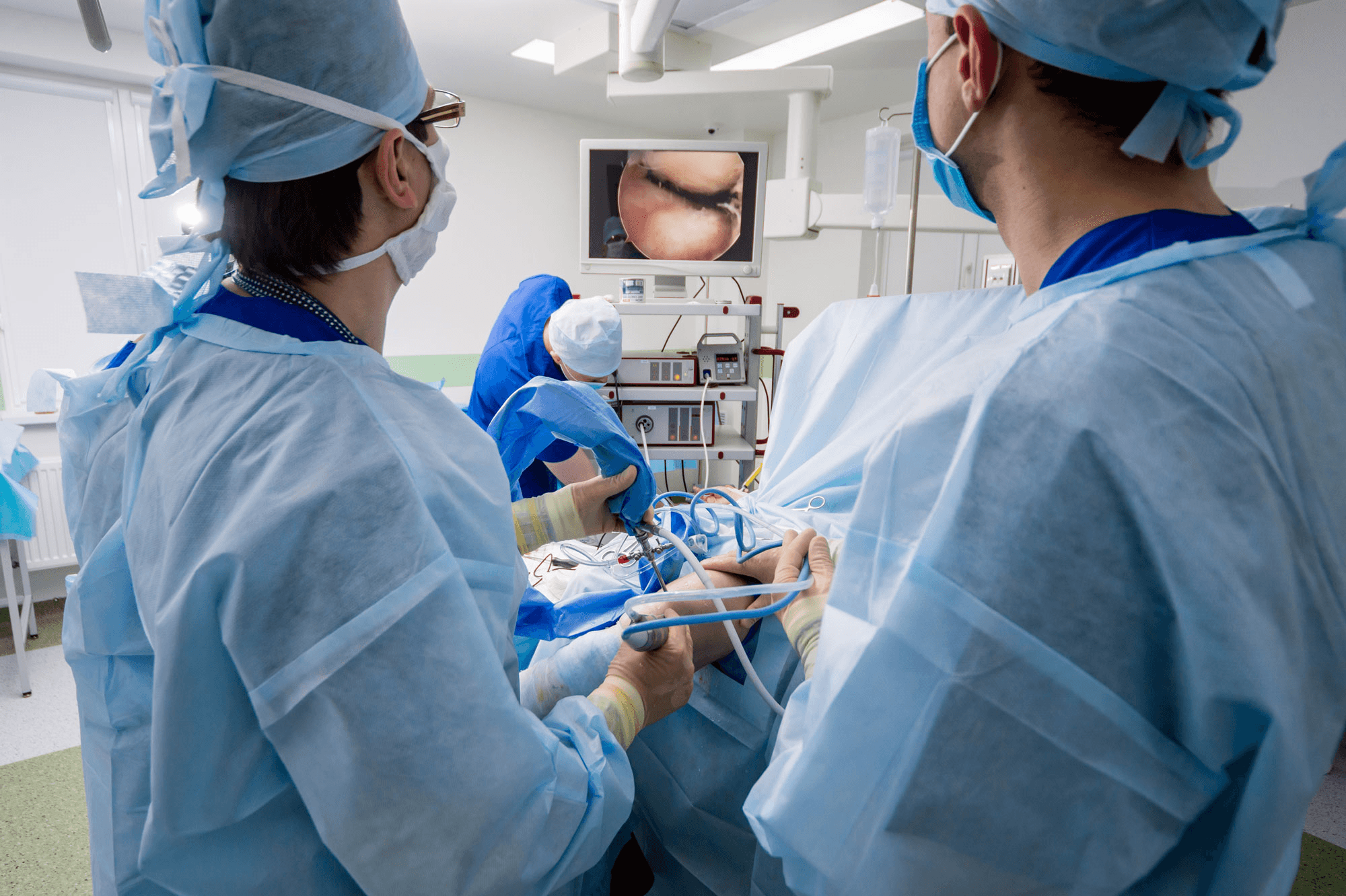

ChondroFiller Injection for Grade III and IV Osteoarthritis
Can a ChondroFiller injection work when your OA is already advanced?
Being told your knee is 'bone on bone' does not automatically mean joint replacement is your only path forward. ChondroFiller injection is explicitly designed for the kind of diffuse, multi-surface articular wear that characterises Kellgren-Lawrence Grade III and IV osteoarthritis — not reserved for the early, contained focal lesions that dominate conventional surgical cartilage-repair literature.
The injectable collagen scaffold works differently from surgical cartilage procedures: rather than requiring a surgically prepared, dry joint bed, it is administered directly into the natural fluid environment of the joint under ultrasound or fluoroscopic guidance. The scaffold coats whatever articular surface remains — including bone-on-bone presentations — self-gelling within minutes to provide a structural matrix that the body's own cells can migrate into and build upon. There is no defect-size ceiling and no upper age limit for this injectable route, making it particularly relevant for active patients in their 60s, 70s and beyond who have been advised to consider joint replacement but wish to attempt preservation first.
Delivery is an outpatient procedure completed in a single clinic visit, with no general anaesthetic and no operating theatre required. For patients at this stage of OA, it represents a preservation-first option that is worth discussing in a specialist assessment before committing to any surgical pathway.
Why injectable ChondroFiller suits diffuse wear, not just focal defects
Surgical cartilage repair procedures — microfracture, ACI, and the arthroscopic Liquid Cartilage™ keyhole operation — work by removing damaged tissue, preparing a clean defect bed, and implanting repair material into that prepared space. They are, in that sense, subtractive: healthy surrounding cartilage is required for the procedure to succeed, and a contained, single focal lesion in an otherwise intact joint is the ideal candidate.
The injectable ChondroFiller pathway inverts that logic entirely. Rather than requiring debridement or a surgically dried joint environment, the collagen scaffold is delivered into the joint's existing fluid and lays itself over whatever articular surface is present — spreading across degenerated, thinned, or absent cartilage without needing a pristine host bed. Diffuse, multi-surface wear is not a complication to work around; it is the very pattern the injection is designed to address.
This is why the two routes serve distinct patient profiles. The arthroscopic focal-defect procedure suits patients with a single, contained lesion in an otherwise healthy joint — a meaningfully different clinical picture from advanced KL Grade III/IV osteoarthritis. For the latter group, where damage spans broad articular areas and the surgical route would be neither practical nor indicated, the injectable pathway exists as a purpose-built alternative rather than a fallback.
The eligibility criteria that actually matter
Three mechanical questions — not the grade of osteoarthritis — guide the suitability assessment for ChondroFiller injection.
Ligament stability. The joint must have no untreated ligament deficit. An unrepaired cruciate or collateral injury creates an unstable mechanical environment in which the scaffold cannot fulfil its role; the biomechanical foundation needs to be sound before the repair matrix is introduced. Ligament instability that has already been treated does not exclude a patient.
Alignment. Significant malalignment — a pronounced varus or valgus deformity that concentrates the majority of load through a single compartment — can undermine any cartilage repair strategy if left unaddressed. The clinical assessment determines whether alignment falls within a workable range or whether correction should come first.
Meniscal status. A meniscal deficit that is actively driving progressive wear needs to be resolved before or alongside the injection. Incidental meniscal changes present alongside advanced OA do not, of themselves, exclude a patient.
Notably absent from this list are age and OA severity. Kellgren-Lawrence Grade III and IV presentations are the intended population for the injectable route, not an exception to it. There is no upper age limit on the protocol — a design choice that reflects genuine suitability for patients in their 60s, 70s and beyond, not simply a commercial inclusion. Whether these mechanical prerequisites are met is confirmed through imaging review and clinical assessment at the London Cartilage Clinic before any treatment plan is agreed.
Next steps
Where to go from here
These routes are selected from the topic and purpose of this article. They are guidance, not a diagnosis or treatment recommendation.
Learn more
Explore liquid cartilage treatment
Talk to the team
Book a free discovery call
What the ChondroFiller injection involves on the day
The appointment at the London Cartilage Clinic on Harley Street is a single outpatient visit. Under ultrasound or fluoroscopic guidance, the clinician confirms needle placement and delivers the ChondroFiller collagen scaffold directly into the joint — the image guidance being critical to precise deposition across the articular surfaces that have been identified on the pre-treatment MRI.
What happens next is the clinically distinctive part. Rather than relying on the clinician to mechanically prepare a defect bed, the scaffold does its own work once inside the joint: on contact with the intra-articular environment, the acellular collagen solution self-gels within minutes, forming a stable matrix over whatever cartilage surface remains. This is not a temporary analgesic or a lubricating filler — the gel creates a structural template designed to recruit the patient's own progenitor cells from the surrounding synovium and subchondral bone. Those cells migrate in, differentiate into chondrocytes, and begin building repair tissue. The scaffold itself biodegrades progressively and is replaced by native tissue as the repair process matures. The formal term for this is acellular matrix-induced chondrogenesis: the product supports the body's own repair processes rather than introducing exogenous cells or synthetic material that remains permanently in the joint.
The injection is single-session. A six-week clinical review is included in the guide cost of £3,000, covering a check on early tissue response and onward physiotherapy planning.
Treatment protocols for severe and end-stage cases
Not every advanced joint presents the same challenge. In many KL Grade III/IV cases, the primary problem is the articular surface — cartilage degeneration and bone-on-bone loading — which the ChondroFiller injection addresses directly. In a significant proportion of patients at this stage, however, the synovial lining has also deteriorated: thickened, inflamed, and no longer able to maintain the intra-articular environment that repair tissue needs.
For those patients, the Dual-Active Therapy combines ChondroFiller injection on the bone surfaces with Arthrosamid (a polyacrylamide hydrogel) on the synovium, both delivered in a single clinic visit. These two components are not interchangeable, and they are not blended into one product — they work through distinct mechanisms. ChondroFiller is the regenerative scaffold, designed to recruit the patient's own progenitor cells and support cartilage repair. Arthrosamid is a non-regenerative hydrogel that integrates into the synovial lining to provide mechanical buffering; it does not repair cartilage. The guide cost for this combined protocol is approximately £6,000, confirmed by the treating clinic.
The most severe presentations — where structural shielding, synovial support, and additional cellular signalling are all judged necessary — may be escalated to a Triple-Active Therapy, adding autologous mesenchymal stem cells (harvested from bone marrow, fat, or ear cartilage) at a guide cost of approximately £11,000.
Whichever tier is used, a Longitudinal Lifetime Program provides the maintenance framework: annual MRI to monitor repair tissue, annual peptide support, and biennial ChondroFiller top-up injections — framing treatment not as a single-point intervention but as a sustained joint-preservation strategy over years.
Outcomes: what clinical data shows and where evidence is limited
Published outcome data for ChondroFiller should be read with one important distinction in mind: the IKDC and MOCART figures that anchor the evidence base derive primarily from the arthroscopic surgical application in contained focal defects, not from the injectable, image-guided delivery route used for diffuse KL Grade III/IV wear. Stating that at the outset, rather than after the numbers, is the honest way to frame what follows.
With that context established, the published clinical record is encouraging. Across four knee studies — anchored by the Jerosch et al. post-market clinical follow-up trial — mean IKDC patient-reported scores improved by approximately 32 points at three-year follow-up, with patients reaching functional scores of around 80. The established minimally clinically important difference for the IKDC is 16.7 points; a 32-point gain roughly doubles that threshold. MOCART imaging in European studies confirmed greater than 80% defect filling, with scores rising from 65.3 at four weeks to 81.6 at one year — a trajectory of progressive, not static, repair tissue maturation.
On safety, ChondroFiller carries an approximately 0% complication rate and a reoperation rate of 3–8% in published series, comparing favourably with microfracture (up to 41% reoperation) and ACI or MACI (up to 37% reoperation, with complication rates reaching 17%).
The evidence gap matters, however. The clinical basis for the injectable pathway in advanced, diffuse KL Grade III/IV OA rests substantially on manufacturer-sponsored documentation; independent peer-reviewed RCT data for this population and delivery route remain limited. Patients considering this route should ask their clinician directly what outcome evidence applies to their specific presentation — not simply whether the headline IKDC figures translate.
For those who meet the three mechanical prerequisites, an assessment at the London Cartilage Clinic on Harley Street — where MRI pattern, joint condition, and realistic expectations can be properly matched to the available evidence — is the logical next step. Appointments can be arranged via londoncartilage.com.
Frequently Asked Questions
- Yes. ChondroFiller is explicitly designed for advanced bone-on-bone wear in Kellgren-Lawrence Grade III and IV osteoarthritis, not just early focal defects. It coats existing articular surfaces without requiring surgical preparation.
- Surgical procedures require debridement and a dry joint bed. ChondroFiller is injected into the fluid joint environment and spreads over degenerated cartilage without prior preparation, making it suitable for diffuse wear.
- Three mechanical prerequisites: stable ligaments (untreated instability excludes patients), acceptable alignment, and any significant meniscal deficit must be resolved. Age and osteoarthritis grade alone do not exclude patients.
- The single outpatient procedure uses ultrasound or fluoroscopic guidance to deliver collagen scaffold into the joint. It self-gels within minutes, creating a matrix that recruits your own progenitor cells to build repair tissue.
- ChondroFiller alone costs approximately £3,000. Dual-Active Therapy (adding Arthrosamid) costs about £6,000. Triple-Active Therapy (adding stem cells) costs approximately £11,000. A Longitudinal Lifetime Program provides annual maintenance.
Next steps
Where to go from here
These routes are selected from the topic and purpose of this article. They are guidance, not a diagnosis or treatment recommendation.
Learn more
Explore liquid cartilage treatment
Use a structured overview to narrow down the most useful next step for your situation.
Talk to the team
Book a free discovery call
A non-medical call with the team to understand services and choose the right booking route.
Legal & Medical Disclaimer
This article is published by Liquid Cartilage for general information and education only. It does not constitute medical advice, diagnosis, or treatment.
Always seek personalised advice from a qualified healthcare professional before making decisions about your health. Liquid Cartilage accepts no responsibility for errors, omissions, third-party content, or any loss, damage, or injury arising from reliance on this material.
If you believe this article contains inaccurate or infringing content, please contact us at [email protected].