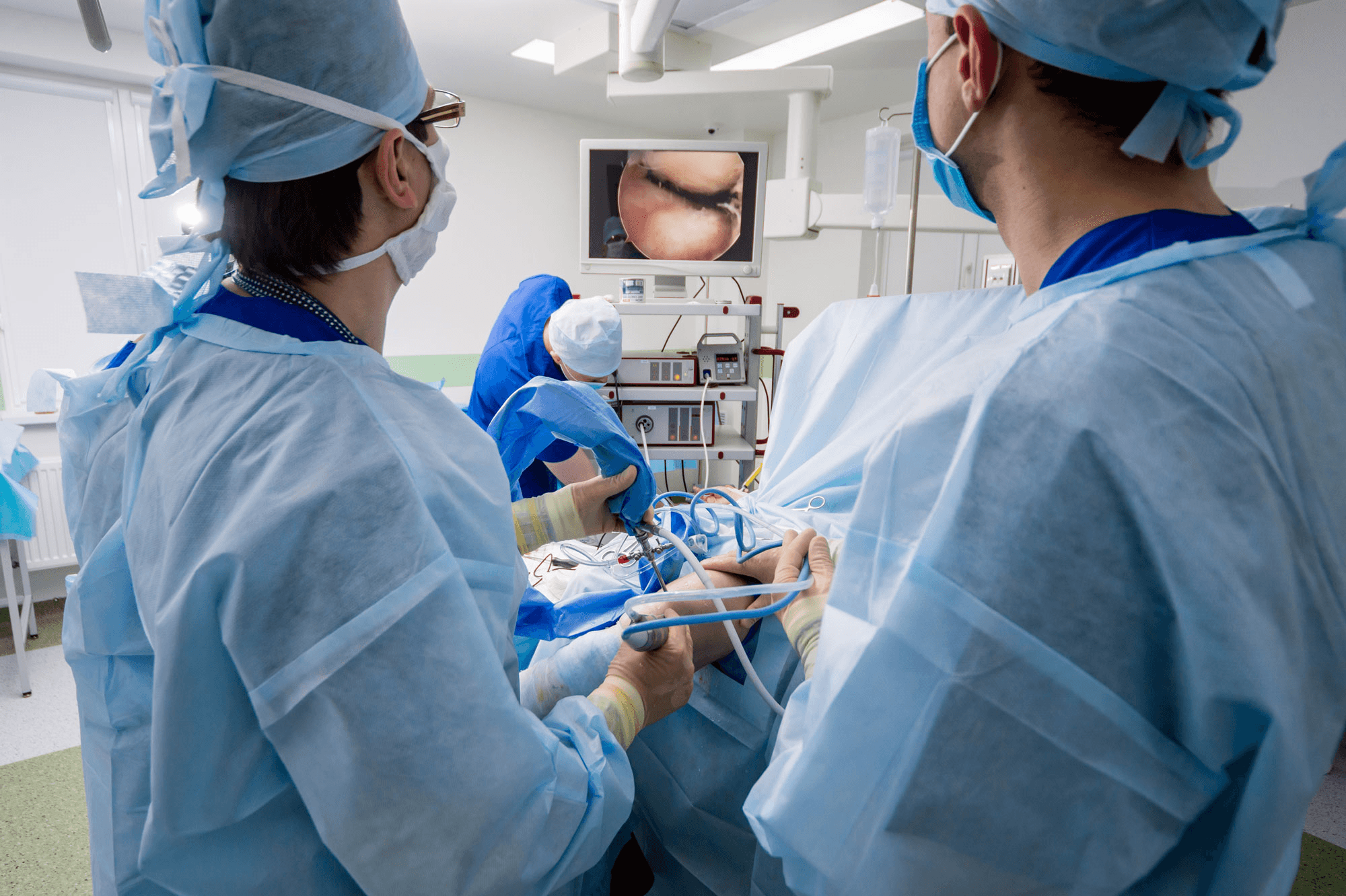

When cartilage damage after ACL rupture needs a specialist
How common is cartilage damage alongside an ACL rupture?
Roughly one in three to one in two people who rupture an ACL also sustain significant cartilage damage at the same time — a 2022 analysis published in Frontiers in Cell and Developmental Biology (Huang et al.) put the incidence of severe concomitant chondral injury between 16% and 46%. That range is wide, partly because cartilage damage is often subtler than the ligament tear on first assessment.
Anatomically, the medial femoral condyle is the most frequently injured cartilage surface in these cases — a finding that can easily be missed, because the bone bruising visible on early imaging tends to appear on the lateral side. Clinical examination and plain X-ray alone are therefore insufficient; MRI is needed to characterise what is actually happening to the cartilage.
The reason this matters biologically is straightforward: articular cartilage has no direct blood supply. Without the vascular repair response that heals most other tissues, meaningful self-repair does not occur. Lesions larger than approximately 1 cm in diameter carry a material risk of gradual enlargement and, eventually, progression toward osteoarthritis. That single biological fact — an absence of vascularity, a size-dependent tipping point — underpins every decision about timing and escalation discussed in the sections that follow.
The 6-month window — and why the risk compounds monthly
The evidence offers genuine reassurance at one end of the timeline. A retrospective comparative study by Utoyo et al. (PMC, 2024) followed 95 patients who underwent ACL reconstruction and found that delaying surgery by three to six months carried no statistically significant increase in the risk of secondary meniscus injury. For patients who are not yet surgical candidates — or who need time to reduce swelling and regain range of motion before any intervention — that finding supports a structured, unhurried conservative period rather than a rush to theatre.
Beyond six months, however, the picture shifts sharply. In the same cohort, a delay of six to twelve months was associated with an odds ratio of 4.35 (95% CI 1.13–16.79) for meniscus injury — meaning the odds of additional joint damage more than quadrupled compared with earlier reconstruction. Delay beyond twelve months carried an odds ratio of 10.68 (95% CI 2.55–42.22): roughly ten times the baseline risk. More telling still, the risk does not jump abruptly at a single threshold; it compounds at approximately 12% for each additional month of delay (OR=1.12 per month; p=0.003). Waiting an extra season is not a neutral choice.
This is Level III evidence from a relatively small cohort, and the outcome measured is meniscus injury rather than cartilage deterioration specifically — a proxy rather than a direct cartilage endpoint. That does not make the data less actionable; it means it should be read alongside clinical judgement rather than applied mechanically.
The practical implication is that the six-month mark functions as an active review point. Patients still within the conservative window need not panic — but by that point, progress should be assessed against clear milestones, and anyone not meeting them should be seen by a specialist before the compounding risk curve steepens further.
Free non-medical discussion
Not sure what to do next?
Information only · No medical advice or diagnosis.
What structured conservative management looks like in practice
Conservative management after an ACL rupture with concomitant cartilage injury follows a phased, criteria-based progression — each stage unlocks the next when the knee is ready, not when the calendar says so.
Weeks 0–6 centre on reducing the inflammatory load: controlling swelling, protecting the joint with partial or full weight-bearing as tolerated, and beginning early quadriceps activation (typically isometric contractions and straight-leg raises). A calm, mobile knee is the goal before any loading begins.
Weeks 6–12 introduce controlled loading through closed-chain exercises — think leg press and wall sits rather than open-chain knee extensions — alongside progressive range-of-motion restoration. The aim is to rebuild the structural support around the joint without provoking the effusion that has just settled.
Months 3–6 shift focus to neuromuscular control and proprioception: balance and coordination work that retrains the knee's positional sense, which is frequently disrupted by the original injury. Linear running can be introduced here if the knee remains stable and pain-free — pivoting and multidirectional movement come later, only when strength and control are confirmed.
Beyond six months, if surgery is being planned, return to pivoting sport is gated on measurable criteria — with quadriceps strength at least 90% of the uninjured leg a standard clinical threshold before clearance, alongside full range of motion and no residual effusion.
This last point also explains the value of a 3–6 week prehabilitation phase before any surgical intervention. Operating on a swollen, stiff knee risks post-surgical joint scarring (arthrofibrosis) — a complication that can be harder to reverse than the original injury. Nuffield Health and NHS guidance both endorse this preparatory window, treating it as the first phase of recovery rather than a delay.

Early assessment: the 2-week rule that shapes everything after
Choosing to manage an ACL injury conservatively is clinically sound. Choosing not to see a specialist is a different decision entirely — and an important one to separate.
The British Orthopaedic Association advises that patients with an acute knee injury presenting with haemarthrosis should receive expert clinical assessment within two weeks. That two-week window is not a trigger for surgery; it is the point at which a thorough history, examination, and imaging plan are established, so that whatever follows — conservative rehabilitation or surgical planning — is properly supervised rather than guesswork.
X-ray will not identify most chondral pathology. If symptoms persist beyond one to two weeks, MRI is the appropriate next step: it changes the monitoring plan by revealing whether a concomitant cartilage lesion is present, where it sits, and roughly how large it is. A lesion on the medial femoral condyle — the most common site in ACL-associated injury, despite lateral bone bruising being the more typical initial imaging finding — would not appear on plain film at all.
Early assessment does not commit a patient to theatre. What it does is ensure that the six-month conservative window described above is actively monitored, rather than simply elapsed.
Red flags that should trigger specialist referral before 6 months
Several signs suggest the conservative window should close early — regardless of how many weeks have passed since injury.
Joint locking or catching is the most pressing. A knee that locks, gives way, or catches on a specific movement may have a displaced loose body or an unstable chondral flap that can cause further damage with each episode. This warrants prompt specialist review rather than a wait-and-see approach.
Failure to progress through rehabilitation milestones despite consistent physiotherapy is a meaningful signal. If swelling is not settling, range of motion is not recovering, or strength targets remain out of reach after weeks of adherent work, the underlying cartilage picture may be more complex than initial imaging suggested.
Ongoing effusion beyond six weeks of supervised physiotherapy points to persistent joint irritation and should not be attributed to the ACL injury alone without reassessment.
Lesion size on MRI introduces two imaging-based thresholds worth knowing:
- Defects at or above 1 cm, particularly Grade 3–4 (greater than 50% cartilage depth, or reaching subchondral bone), carry a meaningfully higher risk of progression toward osteoarthritis without active management.
- Defects at or above 3 cm² shift the treatment options: these lesions may warrant consideration of scaffold-based or cell-based repair rather than marrow-stimulation techniques alone.
Patients are unlikely to know these measurements without a formal review — which is precisely why early assessment, not symptom monitoring alone, matters.
One further caution: IKDC and KOOS functional scores have been shown to be equivalent across delay groups at one year, meaning feeling broadly well does not confirm that cartilage damage is stable. A comfortable knee is not the same as a safe one.
What happens after escalation to a cartilage specialist
Arriving at a cartilage specialist is the point at which the clinical picture sharpens from 'ACL injury with possible cartilage involvement' to a specific defect — graded by size, depth, and location — with a treatment trajectory attached.
What the assessment involves
A specialist review typically combines a detailed MRI read (sometimes a higher-resolution sequence than the initial scan), clinical examination, and a shared discussion about what the findings mean for the patient's activity goals. Lesion grading — Grade 3 for depth exceeding 50% of cartilage thickness, Grade 4 for lesions reaching subchondral bone — shapes which options are realistically on the table.
Treatment options and how they are selected
For smaller focal defects, broadly under 2–4 cm², marrow stimulation techniques such as microfracture are often discussed first. These create conditions for fibrocartilage repair tissue by encouraging bleeding from the underlying bone.
An injectable collagen scaffold, placed via ultrasound-guided outpatient injection, is a further option for eligible focal defects. The scaffold gels within the defect and provides a matrix that may recruit the patient's own progenitor cells to form repair tissue. Suitability depends on lesion characteristics and clinical judgement at assessment.
For larger defects at or above 3 cm², cell-based repair carries stronger supporting evidence. The SUMMIT trial found improved KOOS pain and function scores at two and five years with MACI compared with microfracture for lesions of this size. OATS (osteochondral autograft transfer) is a further surgical option, particularly for full-thickness defects in younger, active patients.
None of these routes is universally superior; the decision turns on defect geometry, age, activity level, and prior treatment history. Patients who wish to explore the injectable scaffold pathway can find further information and request an assessment at the London Cartilage Clinic on Harley Street via londoncartilage.com.
Frequently Asked Questions
- Between one in three and one in two ACL ruptures involve significant cartilage damage. A 2022 analysis found incidence between 16 and 46 percent, varying partly because initial imaging often misses subtler chondral injury.
- Articular cartilage lacks direct blood supply, preventing the vascular repair response that heals other tissues. Lesions larger than about 1 cm carry meaningful risk of gradual enlargement and progression toward osteoarthritis.
- The British Orthopaedic Association advises expert assessment within two weeks of acute knee injury with haemarthrosis. Early assessment establishes a monitoring plan without committing you to surgery.
- Joint locking or catching, failure to progress through rehabilitation despite physiotherapy, ongoing swelling beyond six weeks, or MRI findings of defects at or above 1 cm warrant prompt referral.
- Beyond six months, delay risk compounds at approximately 12 percent monthly. Six to twelve month delays carry 4.35 times baseline odds of secondary meniscus injury; beyond twelve months, odds rise to 10.68 times.
Legal & Medical Disclaimer
This article is written by an independent contributor and reflects their own views and experience, not necessarily those of Liquid Cartilage. It is provided for general information and education only and does not constitute medical advice, diagnosis, or treatment.
Always seek personalised advice from a qualified healthcare professional before making decisions about your health. Liquid Cartilage accepts no responsibility for errors, omissions, third-party content, or any loss, damage, or injury arising from reliance on this material.
If you believe this article contains inaccurate or infringing content, please contact us at [email protected].