
When bracing osteotomy and chondroplasty make sense
Which option fits the problem
Rather than treating them as three versions of one treatment, the practical split is by job. An unloader brace is the non-surgical option: it aims to ‘buy time’ by shifting load away from the sore compartment, and 52-week randomised evidence suggests it can improve pain and function in unicompartmental knee osteoarthritis. Osteotomy is different. HTO or DFO changes alignment so the forces through the knee are altered more fundamentally, which is why it belongs in joint-preserving surgery rather than simple symptom control. Chondroplasty is different again: an arthroscopic ‘clean-up’ that smooths unstable cartilage flaps or edges that catch and irritate the joint.
The fork in the road is usually anatomy and disease pattern. Varus alignment with medial compartment overload points towards HTO; valgus alignment, especially when the deformity comes mainly from the distal femur, points towards DFO. In younger, active patients with symptomatic unicompartmental wear, recent 2025 comparative data suggest realignment may achieve more than bracing when malalignment is the main driver, although a brace may still serve as a holding measure. Chondroplasty fits a narrower problem: a focal unstable flap causing catching or irritation, not diffuse osteoarthritis and not cartilage regrowth. In the preservation pathway before replacement, bracing manages symptoms, osteotomy changes mechanics, and cartilage restoration is a separate decision.
When a brace is enough for now
For some people, a brace is ‘enough for now’ when the aim is simpler than structural repair: make walking, stairs, commuting or standing through a workday more tolerable while keeping surgery in reserve. The best-supported benefit is in unicompartmental knee osteoarthritis: randomised evidence over 52 weeks suggests an active unloader brace can improve pain-related scores and function more than a placebo brace. That makes it most useful as a symptom-control tool for someone with one overloaded side of the knee who wants to stay active, delay an operation, or test whether offloading changes the pattern of pain.
Its job is mechanical. A valgus unloader brace shifts some force away from the more worn medial compartment during gait, so each step may hurt less. Biomechanical modelling supports that basic idea, but it also shows the trade-off: the more correction applied, the more load can be transferred to the lateral compartment. In plain terms, a brace needs to unload without pushing the knee too far the other way.
What it usually cannot do is fix the underlying alignment problem or reliably alter the disease course over the long term. Evidence for symptom relief is stronger than evidence that bracing preserves cartilage or slows progression on imaging. In practice, that is why bracing often works best as a monitored bridge — alongside review of symptoms, function and, where relevant, imaging — rather than as a definitive answer to a malaligned knee.
Free non-medical discussion
Not sure what to do next?
Information only · No medical advice or diagnosis.
When realignment is the bigger lever
Osteotomy comes into its own when malalignment is not just accompanying the knee problem but driving it. In the joint-preservation literature, HTO and DFO are mainly described for younger, active patients with symptomatic unicompartmental disease, where one side of the knee is being overloaded step after step. That helps explain why a 2025 randomised trial in younger patients with medial compartment osteoarthritis found greater 12-month pain improvement after HTO than after valgus unloader bracing: surgery can reset the line of force through the leg, not simply cushion its effects.
The practical selection logic is anatomical. A bow-legged (varus) limb with medial compartment overload usually points towards high tibial osteotomy, because the tibia is often the key site for shifting the weight-bearing axis away from the worn inner side. A knock-kneed (valgus) limb with lateral compartment overload points towards distal femoral osteotomy, especially when the deformity sits mainly in the distal femur rather than the tibia. That is why the choice is not made simply by asking which side hurts. This supports the basic rule: correct the deformity where it actually lives.
Some knees are more mixed than that. When both the femur and tibia contribute meaningfully to varus, a double-level osteotomy may be the cleaner option. In a 58-case series with a mean follow-up of about 10.8 years, combined correction produced durable alignment change with low complication rates, improving the mechanical tibiofemoral angle from -12.7° varus to -0.4°. In that setting, realignment can be the bigger lever because it addresses the underlying geometry of overload rather than trying to offset it from the outside.

What chondroplasty can actually relieve
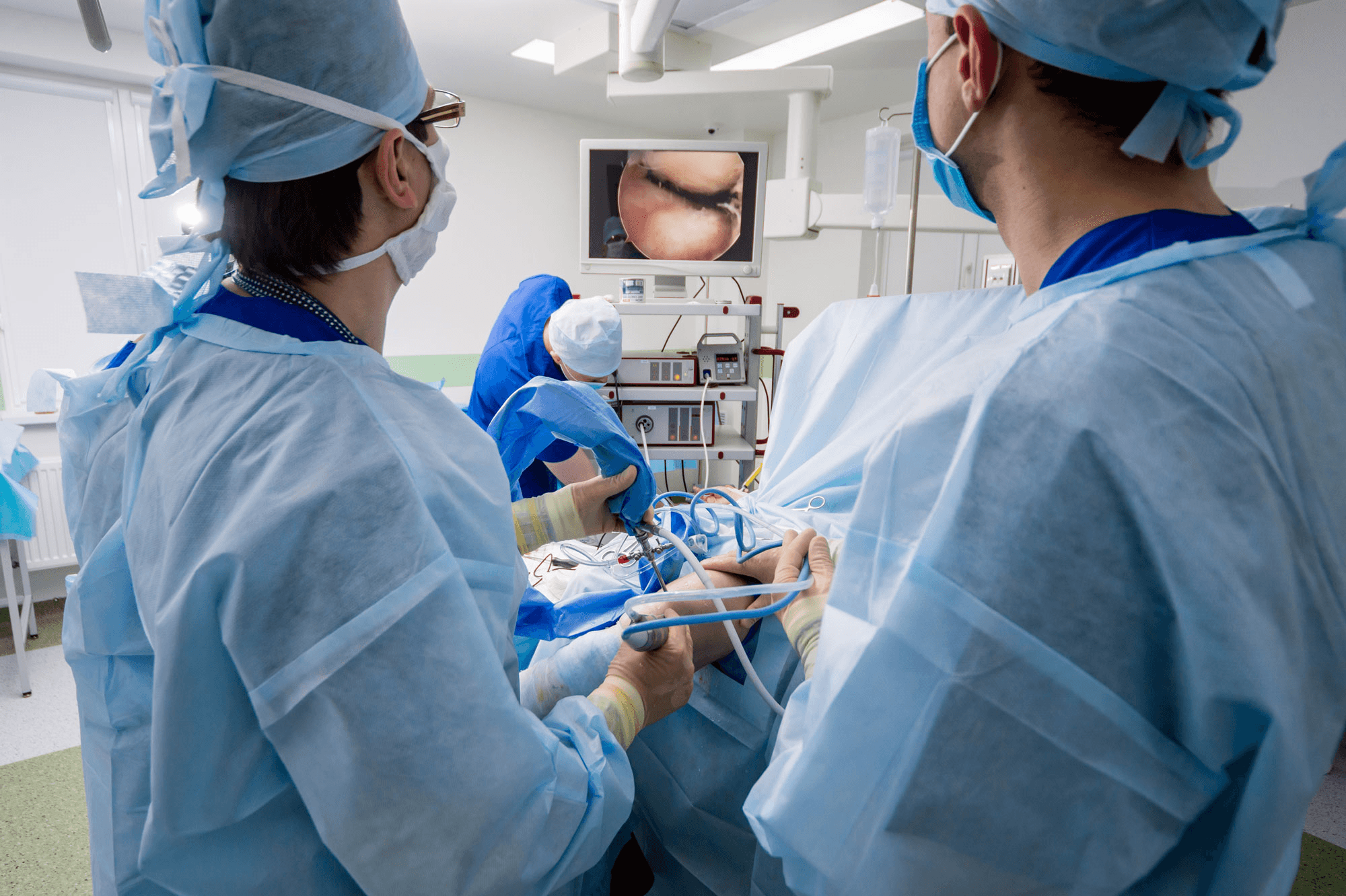
Chondroplasty has a much narrower job than its name can imply. In arthroscopy, it is essentially a cleanup procedure: the surgeon trims or smooths unstable cartilage flaps and rough edges that are mechanically impinging in the joint. That is why it can relieve catching, local mechanical irritation and some pain linked to those unstable surfaces. A useful plain-English summary is: chondroplasty can tidy unstable tissue; it cannot rebuild missing cartilage.
That distinction is borne out by the evidence. Articular cartilage has little meaningful intrinsic repair, so debridement should not be presented as a cartilage-regrowth treatment. Its role is symptom relief in a selected lesion, not structural restoration of a worn compartment. In a study of focal knee cartilage lesions, mechanical chondroplasty was reported to be beneficial particularly when there was no established osteoarthritis and no major concurrent pathology such as significant meniscal disease.
Registry data point in the same direction, but with limits. In the German Cartilage Registry, 126 patients with focal chondral defects showed significant improvement in KOOS subscales over 12 months after debridement. Even so, the benefit was less complete when larger defects were combined with partial meniscus resection: some KOOS domains and numerical pain scores did not improve significantly in that subgroup. So chondroplasty may ease symptoms from unstable cartilage in the right setting, but broader joint degeneration usually calls for a different conversation than simple debridement.
When symptom relief is not enough
A more useful dividing line at this stage is not brace versus arthroscopy versus osteotomy, but "symptom control" versus "structural preservation". When the problem is diffuse or advanced osteoarthritis across a wider area of the joint, treatment goals usually centre on pain reduction, walking tolerance and delaying replacement where possible. In that setting, bracing and arthroscopic tidying mainly help by making an overloaded or irritated knee more manageable. Osteotomy sits further along the preservation pathway because it can change the limb’s mechanics when varus or valgus alignment is the main reason one compartment is being repeatedly overloaded.
The conversation changes when imaging and examination point to a "focal cartilage defect" in an otherwise salvageable joint. Here, repeated symptom-control measures may not be the most relevant question. The more important question is whether there is a contained area that is suitable for cartilage restoration rather than simple trimming or load-shifting alone. In plain terms, restorative treatment aims to fill or resurface a local defect; chondroplasty does not do that, and bracing does not attempt to do it from the outside.
That is the point at which options such as Liquid Cartilage™ (ChondroFiller™) enter the pathway. It is a single-stage, minimally invasive collagen scaffold designed for suitable focal defects, where it gels within the defect and supports matrix-induced chondrogenesis using the patient’s own repair response. It is not a treatment for diffuse end-stage OA. In some knees, this is not an either-or choice: correcting alignment with HTO or DFO may be combined with cartilage restoration when both mechanics and a local defect need attention.
What an assessment should clarify
Before any treatment is named, the assessment needs to settle a short list of practical points:
- which compartment is overloaded — "medial" or "lateral";
- whether the malalignment comes mainly from the tibia, the distal femur, or both;
- whether the cartilage problem is a "focal defect" or more diffuse wear;
- whether there are unstable flaps or loose edges causing mechanical irritation;
- how much osteoarthritis is already established on weight-bearing X-rays, long-leg alignment views and, where needed, MRI.
That work-up is there to sort the knee into the right pathway first, not to jump from symptoms straight to a named procedure. The same complaint on stairs may fit temporary bracing, a varus or valgus knee that needs an osteotomy discussion, or a contained defect where cartilage restoration is more relevant than simple debridement. The most useful consultation therefore covers both sides of the decision: what a treatment may help, and what it cannot correct if the joint pattern is wrong. Suitability depends on the defect pattern, overall joint status and alignment.
In London, Liquid Cartilage™ is delivered in the UK at the London Cartilage Clinic on Harley Street, and assessment can be booked via londoncartilage.com.
- [1] Unloader brace or high tibial osteotomy in the treatment of the young patient with medial knee osteoarthritis: a randomized controlled trial. (2025). https://doi.org/10.2340/17453674.2025.42846 https://doi.org/10.2340/17453674.2025.42846
Frequently Asked Questions
- It is most useful for unicompartmental knee osteoarthritis when the aim is symptom relief, such as easier walking, stairs or standing, while keeping surgery in reserve. Evidence over 52 weeks suggests pain and function can improve.
- A valgus unloader brace shifts force away from the more worn medial compartment during gait. It can reduce pain, but it may also transfer more load towards the lateral compartment if overcorrected.
- Osteotomy is better when malalignment is driving overload, especially in younger, active patients with symptomatic unicompartmental disease. It changes the line of force through the leg rather than only easing symptoms.
- Varus alignment with medial compartment overload usually points towards high tibial osteotomy. Valgus alignment, especially when the deformity is mainly in the distal femur, points towards distal femoral osteotomy.
- Chondroplasty can tidy unstable cartilage flaps or rough edges that catch and irritate the joint. It may ease catching and local pain, but it cannot rebuild missing cartilage or treat diffuse osteoarthritis.
Legal & Medical Disclaimer
This article is written by an independent contributor and reflects their own views and experience, not necessarily those of Liquid Cartilage. It is provided for general information and education only and does not constitute medical advice, diagnosis, or treatment.
Always seek personalised advice from a qualified healthcare professional before making decisions about your health. Liquid Cartilage accepts no responsibility for errors, omissions, third-party content, or any loss, damage, or injury arising from reliance on this material.
If you believe this article contains inaccurate or infringing content, please contact us at [email protected].