
When a hip labral tear involves cartilage damage
Why cartilage damage changes your treatment pathway
If your scan report mentions both a labral tear and cartilage damage, it is natural to wonder whether the cartilage finding is the scan radiologist adding detail — or whether it actually changes what happens next. The short answer is that it changes quite a lot.
A labral tear and concurrent chondral damage are two structurally distinct problems. The labrum is soft tissue; articular cartilage is a load-bearing surface. Conservative care — physiotherapy, anti-inflammatories, and an intra-articular injection — can manage symptoms and may be sufficient for many presentations. But articular cartilage has very limited capacity to repair itself, so when the damage is more than superficial, conservative measures address the pain without resolving the underlying tissue loss.
The grade of cartilage damage — how deep it runs — is the single biggest variable shaping the treatment plan beyond the labrum itself. Shallow damage and full-thickness cartilage loss are not just different in degree; they open different clinical pathways with different realistic outcomes.
One further practical point: imaging frequently underestimates the true extent of chondral injury. Many patients do not learn the full picture until the cartilage surface is viewed directly — which is why the grade of damage, and what it means for treatment, is worth understanding before that stage.
Why these two injuries tend to happen together
Most hip labral tears do not arise from a single traumatic event. The more common cause is femoroacetabular impingement (FAI) — a mismatch between the shape of the femoral head and the acetabular socket that creates repeated abnormal contact at the end of hip movement. Think of a door that repeatedly catches its frame rather than closing cleanly: each cycle grinds both the frame edge and the surface immediately behind it. In the hip, that grinding simultaneously abrades the rim of the acetabulum, tears the labrum attached to it, and scrapes the articular cartilage just beneath — which is why the two injuries appear together so often.
The labrum does more than line the socket. It forms a hydraulic seal that keeps synovial fluid pressurised across the cartilage surface, and it spreads joint load so that no single area of cartilage bears the full burden during movement. When the labrum tears, both functions are lost: fluid escapes, localised pressure on the cartilage rises, and wear accelerates at precisely the point already damaged by the original impingement contact.
The result is a self-reinforcing cycle. Cam morphology — an aspherical femoral head — tends to concentrate damage at the anterosuperior acetabulum; pincer morphology, where the socket over-covers the femoral head, can produce circumferential rim damage; mixed FAI typically leads to the most extensive chondral changes. This mechanical linkage is why assessing both structures at diagnosis, rather than treating the labral tear as the only finding that matters, determines how the treatment pathway is mapped.
Free non-medical discussion
Not sure what to do next?
Information only · No medical advice or diagnosis.
What assessment and imaging reveal — and where they fall short
Pinning down the grade of cartilage damage involves several overlapping steps, each answering a slightly different clinical question.
Clinical examination comes first. Hip impingement tests — the FADIR manoeuvre (flexion, adduction, internal rotation) being the most widely used — can reproduce a patient's pain and indicate the likely source, but they cannot grade cartilage. Range-of-motion testing and symptom pattern, including the location, character, and triggers of the pain, direct the choice of imaging that follows.
Plain X-rays are taken to assess bony FAI morphology and to apply the Tönnis classification of radiographic osteoarthritis. Tönnis Grade 0–1 indicates a joint likely suitable for preservation surgery; Grade 2 or above — visible joint-space narrowing and subchondral sclerosis — substantially narrows arthroscopy candidacy and carries prognostic weight in its own right.
MR arthrography (direct, with intra-articular contrast) is the most sensitive pre-operative imaging test for labral pathology. It can identify chondral lesions, but consistently underestimates their true depth and extent. The Outerbridge/ICRS grading system — running from Grade I (surface softening) through to Grade IV (full-thickness loss down to bare bone) — is the classification surgeons use to drive operative decisions, and in practice that grade is often only confirmed when the cartilage surface is viewed directly at arthroscopy. Many patients are genuinely surprised to learn the scan does not give the full picture.
A diagnostic intra-articular injection of local anaesthetic, sometimes combined with corticosteroid, tests whether the hip joint is the primary pain generator. A meaningful reduction in pain after injection provides clinical evidence — for both patient and clinician — that the joint, rather than surrounding soft tissue or a referred source, is driving the symptoms. This step frequently informs the decision about whether to proceed to surgery.

The conservative stage and who it is likely to help
The first-line pathway is the same whether cartilage damage is mild or more advanced: structured physiotherapy, anti-inflammatory medication, and activity modification. The physiotherapy programme — typically running for 10 to 12 weeks — concentrates on the muscles that control hip loading: the gluteal group (particularly gluteus medius), the deep hip stabilisers, and the core. These are not simply general strengthening exercises; better-coordinated stabilisers reduce the peak load crossing the damaged cartilage surface on every step, allowing irritated tissue to settle. An intra-articular injection, in addition to its diagnostic role, can support this phase by reducing inflammation enough to allow meaningful engagement with rehabilitation.
Who benefits durably from conservative care depends substantially on chondral grade. Patients with mild-to-moderate damage — Outerbridge Grades I or II — can achieve sustained symptom improvement with physiotherapy alone. Where damage reaches Grade III or IV, the structural loss tends to limit how far rehabilitation can take matters: load can be reduced, but the cartilage defect and the torn labrum remain in place. Research published by Chahla and colleagues in 2019 confirmed that full-thickness Grade IV lesions are associated with substantially worse functional outcomes, pointing to an inherent ceiling on what unassisted conservative care can achieve in these cases.
That distinction is worth naming clearly: conservative care does not repair the labrum or regenerate cartilage. Its role is to reduce mechanical load, calm inflammation, and give both patient and clinician a clearer picture of what the joint can tolerate — all of which feeds into better-informed next steps.
The 10-to-12-week mark is a concrete checkpoint rather than an open-ended commitment. Failure to make meaningful progress at that point is a signal for specialist reassessment and consideration of further intervention — not simply continuing the same programme.
How chondral grade determines the surgical plan
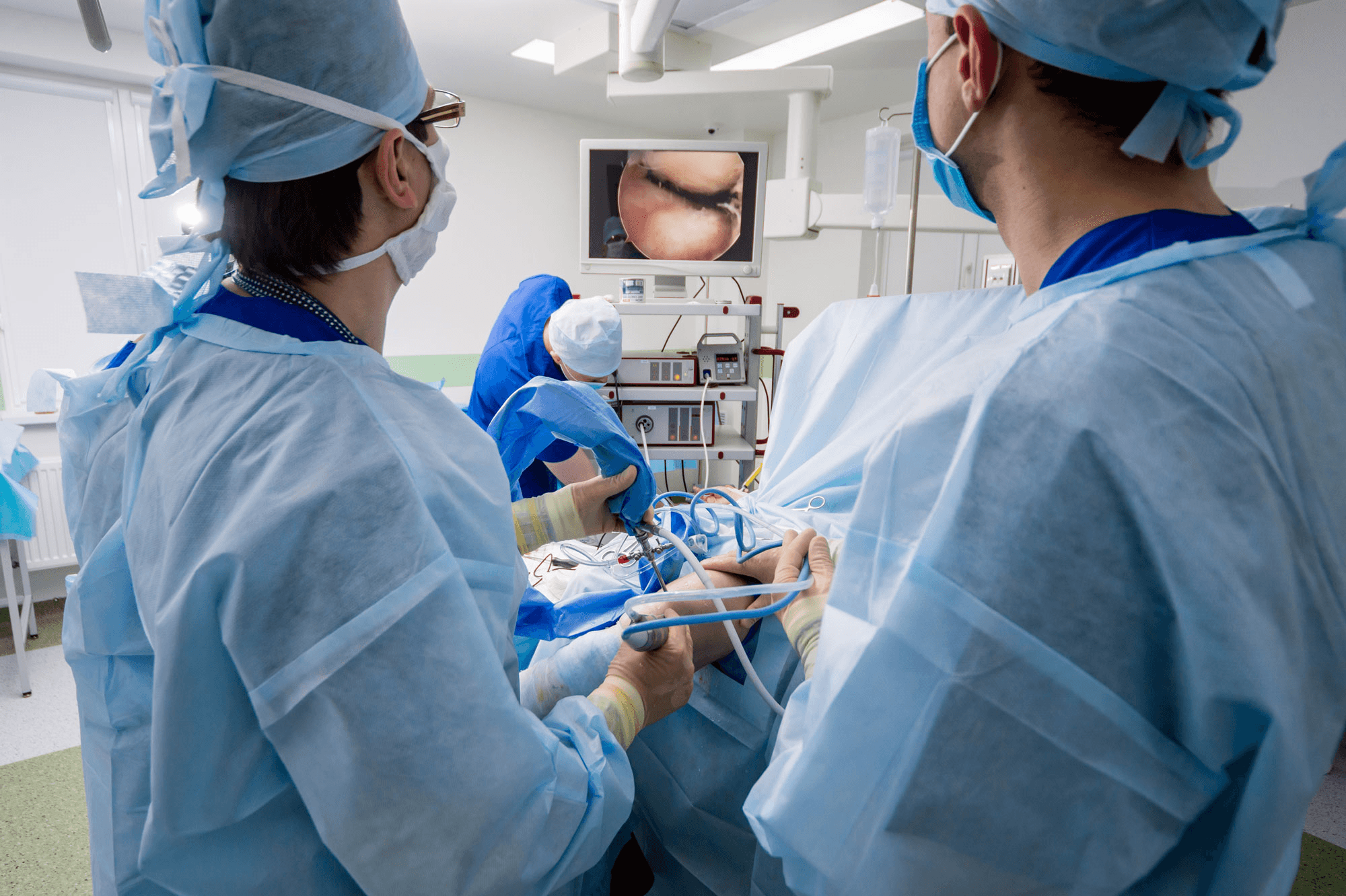
Deciding what to do surgically begins the moment the arthroscope enters the joint. Three problems are addressed in the same procedure — bony FAI correction, the labral tear, and the chondral lesion — but it is the cartilage findings, seen directly for the first time, that determine how much additional work follows.
The labral step: repair over debridement. Where tissue quality allows, surgeons prefer to repair the labrum rather than trim it away. Restoring a functioning suction seal redistributes load back across the joint surface; removing tissue eliminates that protection and leaves residual cartilage exposed to higher peak forces. Debridement is reserved for labral segments too damaged to be anchored back securely.
The chondral step: graded I through IV.
- Grades I–II (surface softening or fissuring to less than half the cartilage depth): the joint surface is smoothed and unstable flaps are stabilised — a technique called chondroplasty. Outcomes in published series are generally satisfactory over short-to-mid-term follow-up.
- Grade III (partial-thickness loss beyond 50% depth): chondroplasty remains the primary step, though the proximity to full-thickness loss narrows the expected margin of recovery.
- Grade IV focal defects (<approximately 400 mm², with intact subchondral bone): microfracture is the most established technique at this stage. Perforating the subchondral plate recruits marrow-derived progenitor cells into the defect, but the tissue that forms is fibrocartilage — mechanically inferior to native hyaline cartilage — and long-term durability is variable.
- Larger or more demanding Grade IV defects (≥3 cm² in particular): scaffold-augmented or cell-based approaches such as AMIC — combining microfracture with a type I/III collagen matrix — or matrix-induced autologous chondrocyte implantation (MACI) are used. Available data, extrapolated in part from knee-based series, suggest better durability than microfracture alone at these sizes, though long-term randomised trial data comparing AMIC to microfracture specifically in the hip remains limited.
Where Tönnis radiographic grading reaches Grade 2 or above — indicating established joint-space narrowing — arthroscopy candidacy narrows sharply and total hip arthroplasty becomes the more realistic discussion, regardless of labral or chondral technique.
What the evidence says about outcomes — and your next step
Prognosis tracks closely with chondral grade — but Grade IV is not a treatment dead-end. Three studies put the outcome data in plain terms.
Chahla and colleagues (2019) found that patients with Grade IV full-thickness defects at hip arthroscopy reported significantly worse functional scores, lower satisfaction, and more persistent pain than those with lower-grade or absent chondral damage. The structural burden narrows the recovery margin — but it also makes timing and technique selection more, not less, consequential.
Redmond and colleagues (2017), in a study of 792 patients followed for at least two years, identified femoral Outerbridge Grades II–IV as an independent predictor of conversion to total hip arthroplasty, alongside older age, lower preoperative Harris Hip Score, and revision status. The pattern is consistent: the greater the cartilage deterioration at the point of arthroscopic intervention, the harder joint preservation becomes to sustain.
Dean and colleagues (2024) added further granularity, identifying breakdown specifically at the chondrolabral junction — where cartilage meets the labrum — as a higher-risk subtype within Grade IV. Patients with this pattern showed worse patient-reported outcomes and higher THA conversion rates, reinforcing the importance of how the labral repair step is approached and sequenced.
Grade IV involvement is, therefore, a serious prognostic marker — not an automatic exclusion from joint preservation, but a signal that the surgical plan needs to be precisely calibrated to defect size, location, and subchondral integrity. For a narrower and distinct group — patients with diffuse early-wear changes in a well-aligned hip, without a focal full-thickness defect or labral tear — an ultrasound-guided ChondroFiller injection at the London Cartilage Clinic on Harley Street (londoncartilage.com) may be a relevant pathway to discuss with a specialist. For anyone whose presentation does match the focal-defect-plus-labral-tear picture described throughout this article, the practical next step is a specialist assessment that integrates imaging grade, clinical findings, and joint geometry — the combination that determines which pathway is actually available.
Frequently Asked Questions
- Cartilage has very limited repair capacity. Shallow damage and full-thickness loss require different clinical pathways with distinct realistic outcomes.
- Femoroacetabular impingement (FAI) causes repeated abnormal hip contact. This grinding simultaneously tears the labrum and scrapes underlying cartilage, injuring both structures.
- No. MR arthrography, the most sensitive pre-operative test, consistently underestimates cartilage depth and extent. The true grade is often confirmed only when viewed directly at arthroscopy.
- Structured physiotherapy usually runs 10 to 12 weeks, targeting gluteal and core muscles. The 10-to-12-week mark is a checkpoint, not an open-ended commitment.
- Microfracture is established for smaller defects. It recruits marrow cells but forms fibrocartilage, which is mechanically inferior to native cartilage, with variable long-term durability.
Legal & Medical Disclaimer
This article is written by an independent contributor and reflects their own views and experience, not necessarily those of Liquid Cartilage. It is provided for general information and education only and does not constitute medical advice, diagnosis, or treatment.
Always seek personalised advice from a qualified healthcare professional before making decisions about your health. Liquid Cartilage accepts no responsibility for errors, omissions, third-party content, or any loss, damage, or injury arising from reliance on this material.
If you believe this article contains inaccurate or infringing content, please contact us at [email protected].