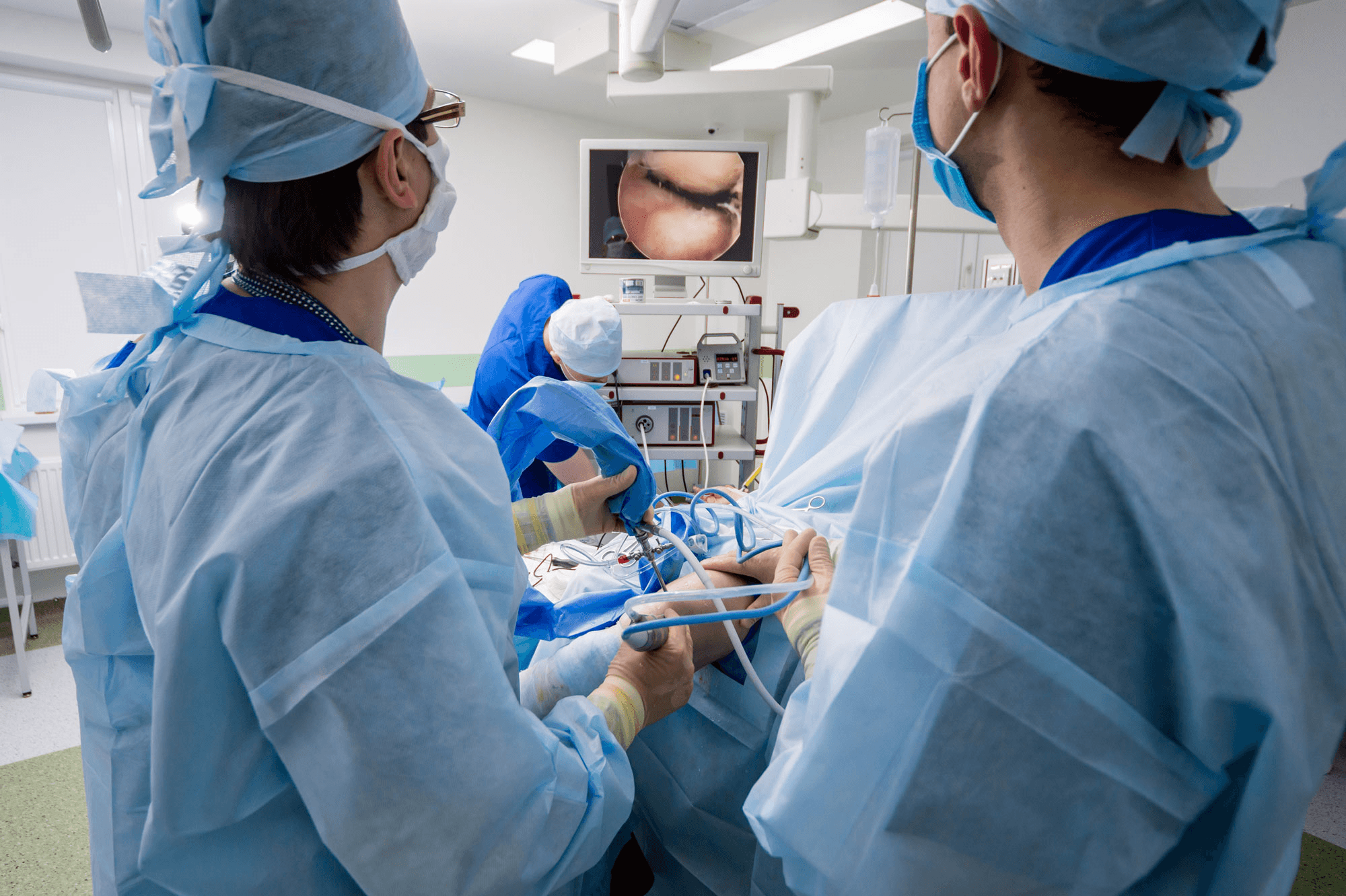

ChondroFiller injection for focal hip cartilage defects
Does my hip qualify for a ChondroFiller injection?
Three questions determine whether a ChondroFiller injection is worth pursuing for your hip: is the damage contained to a specific patch, is the surrounding joint largely intact, and is there enough healthy bone beneath the damaged area for the scaffold to take hold?
Focal damage, not widespread loss. ChondroFiller works by filling a defined, full-thickness cartilage defect — an isolated patch where cartilage has worn away completely, rather than generalised thinning across the joint surface. If your imaging shows diffuse cartilage loss throughout the hip, the injection is not appropriate; it is designed to restore a bounded area, not resurface an entire joint.
Joint status is the key filter. The clearest eligibility marker is Tönnis grade. Patients with grade 0 or 1 — meaning no significant pre-existing arthritis, or only very mild changes — are the strongest candidates. Those with Tönnis grade 2 or 3 osteoarthritis have consistently poor outcomes in published cohort data and are not suitable for this treatment.
Defect size. Focal lesions up to approximately 6 cm² can be addressed; smaller, well-contained defects represent the strongest fit.
Subchondral bone integrity. The scaffold integrates into the bone layer beneath the cartilage. If that underlying bone is significantly compromised, the treatment is unlikely to succeed.
Structural causes. Where femoroacetabular impingement (FAI) is contributing to the damage, addressing it at the same session appears to improve outcomes.
If you have a contained patch of cartilage damage in your hip with no significant arthritis elsewhere in the joint, a ChondroFiller injection assessment is a reasonable next step.
What focal hip cartilage damage looks like
Hip cartilage lines two surfaces simultaneously: the curved acetabulum (the socket) and the femoral head (the ball). A focal defect is a contained lesion on one or both of these surfaces — think of a pothole in an otherwise solid road, surrounded by cartilage that remains structurally sound. Diffuse osteoarthritis, by contrast, resembles a road surface that has crumbled throughout: there is no intact perimeter into which a scaffold can anchor, which is why the two conditions follow different treatment pathways.
ICRS grading and why it matters
Clinicians commonly use the International Cartilage Repair Society (ICRS) scale to classify severity. Grades I and II describe surface softening or partial-thickness fissuring — damage that has not penetrated to bone. Grade III indicates full-thickness loss that reaches the subchondral layer; Grade IV means bone is exposed. ChondroFiller injection is principally aimed at Grade III–IV focal lesions, where there is a clearly defined cavity for the gel to occupy and integrate into.
Common causes in the hip
Femoroacetabular impingement (FAI) — a shape mismatch between the ball and socket — generates repetitive shear forces on the acetabular rim, and is among the more frequent structural causes of focal chondral damage in active adults.
The role of MRI
MRI maps defect location, depth, and the condition of surrounding cartilage and subchondral bone. Imaging findings inform, but do not alone determine, suitability — a clinical assessment alongside the scan is required to put the images in context.
How the ChondroFiller injection works
The distinguishing feature of ChondroFiller injection is that it contains no donor cells at all. Rather than delivering cells from an external source, it works through a process called matrix-induced chondrogenesis: the injectable collagen scaffold creates the right biochemical environment, and the body's own progenitor cells respond by migrating into the defect and laying down new cartilage tissue.
When the gel is placed into the defect under ultrasound guidance, it transitions from liquid to a stable three-dimensional scaffold within minutes. That scaffold then acts as a chemotactic signal — drawing the patient's stem cells and chondrocytes in, where they mature and progressively deposit hyaline-like tissue. As repair proceeds, the collagen matrix gradually resorbs and is replaced by the patient's own regenerating cartilage. Published ex-vivo data recorded a 2.4-fold increase in cell content within 14 days of scaffold placement, reflecting early host-cell recruitment.
Because the procedure is delivered as an ultrasound-guided outpatient injection, there is no operating theatre, no general anaesthesia, and no preliminary biopsy or cell-culture step — the limitations that make two-stage procedures such as ACI or MACI logistically demanding and that carry inherent donor-site morbidity. Everything happens in a single session.
One practical point for the early post-treatment period: the scaffold needs time to stabilise fully before the joint takes normal load. Protected weight-bearing in the weeks following the injection supports integration and appears to reduce the risk of early mechanical disruption to the forming repair tissue.
What the outcome data shows at three to five years
Across the 3–5 year follow-up period of the principal hip cohort (Mazek 2021, n=26), Harris Hip Scores improved by an average of 33 points — a gain that exceeds the threshold generally accepted as clinically meaningful for hip function. Of the 21 patients available at that stage, 17 (81%) recorded good or excellent outcomes.
The cohort enrolled adults with femoroacetabular impingement and full-thickness acetabular lesions larger than 2 cm². Two of the original 26 patients subsequently required a total hip replacement. That figure belongs in the complete picture of outcomes at this follow-up horizon: not every case responds in the same way, and these results reflect a real-world distribution rather than a curated best-case series.
What the MRI data adds
MRI-documented healing was statistically significant, and MOCART scores across hip studies range from 70 to 87 out of a possible 100. MOCART is a validated imaging scoring system that rates how completely and how well repair tissue has filled the original defect; scores in the 70–87 range indicate substantial and progressive defect filling, with higher values observed at longer follow-up intervals — consistent with the gradual cellular maturation the scaffold supports over time. A 2025 case report further confirmed that the approach is applicable to isolated osteochondral defects of the femoral head, not only the acetabulum, broadening the anatomical scope of published hip experience.
The evidentiary ceiling
The hip evidence base currently rests on small prospective cohorts rather than large randomised trials. These are genuinely encouraging findings, but they are not the same as the multi-centre RCT data that would establish long-term superiority over alternative repair approaches. Success rates for symptom relief of 70–85% across cartilage repair methods broadly are comparable to other techniques, and ChondroFiller injection has not yet been shown in controlled trials to exceed them.
How a ChondroFiller injection compares to surgical alternatives
If your consultant has discussed microfracture as an option, the practical differences are worth understanding clearly. Microfracture is a theatre-based surgical procedure — it involves perforating the subchondral bone to stimulate a healing response, but the tissue that forms is fibrocartilage, a mechanically inferior substitute that tends to deteriorate from around two to three years onwards. It also damages the subchondral bone plate, which can narrow the options if further repair is needed later. Published reoperation rates for microfracture run as high as 41%, compared with 3–8% for ChondroFiller injection across reported series. ChondroFiller injection also treats larger defects — up to approximately 6 cm² — whereas microfracture has historically been applied to lesions under 2 cm².
Cell-based procedures such as ACI and MACI are theatre-based two-stage operations: a first surgical session to harvest cartilage cells, a culture period, then a second procedure to implant the cell-seeded construct. Complication rates for ACI approach up to 17%. Where Harris Hip Score improvements in published hip series are compared, both pathways produce gains in the region of 30 points — a similarity that matters, because it means the outpatient injection route is not simply a compromise.
For larger or post-traumatic lesions, osteochondral allograft transplantation — also a theatre-based surgical procedure using donor tissue — is the preferred choice among some US orthopaedic specialists, including opinion from Strickland and Gomoll, who consider cell-based and allograft options the stronger-evidenced approach where they are accessible and appropriate. ChondroFiller injection is acellular; it contains no living donor cells, and that distinction is worth acknowledging honestly.
For patients who cannot or prefer not to undergo two theatre-based procedures, who wish to avoid general anaesthesia, or whose defects fall below the threshold that would typically warrant an allograft, ChondroFiller injection represents a genuine clinical niche rather than a default fallback.
Getting assessed at the London Cartilage Clinic
An assessment at the London Cartilage Clinic on Harley Street reviews your MRI findings, defect location and size, Tönnis grade, and overall joint health to confirm whether ChondroFiller injection is appropriate for your hip. Bringing any existing imaging — particularly an MRI from the past 12 months — helps the consultation run efficiently, though imaging can be arranged if none is available. Professor Paul Y. F. Lee leads ChondroFiller injection delivery in the UK; precise scaffold placement is a meaningful determinant of how well repair tissue forms, and that experience informs the assessment as much as the imaging.
Liquid Cartilage™ is delivered at the London Cartilage Clinic on Harley Street. Book an assessment at londoncartilage.com.
- [1] Arthroscopic utilization of ChondroFiller gel for the treatment of hip articular cartilage defects (Mazek 2021, JHPS). (2021). https://doi.org/10.1093/jhps/hnab002 https://doi.org/10.1093/jhps/hnab002
- [2] Ex Vivo Osteochondral Biomimetic Platform for Cartilage Regeneration (2025). (2025). https://doi.org/10.3390/ijms262311759 https://doi.org/10.3390/ijms262311759
- [3] Randomized multicenter study: ChondroFiller liquid vs microfracturing for focal knee cartilage defects (Schneider 2016). (2016). https://doi.org/10.5348/VNP05-2016-1-OA-1 https://doi.org/10.5348/VNP05-2016-1-OA-1
- [4] Influence of cartilage defects and collagen gel on intact cartilage: biomechanical in-vitro study (2024). (2024). https://doi.org/10.1007/s00402-024-05530-z https://doi.org/10.1007/s00402-024-05530-z
Frequently Asked Questions
- ChondroFiller suits patients with isolated cartilage defects in Tönnis grade 0–1 hips. Defects up to 6 cm² with intact subchondral bone are eligible. Grade 2–3 osteoarthritis disqualifies the treatment.
- The collagen scaffold creates a biochemical environment that draws the body's stem cells and chondrocytes into the defect. These cells mature and lay down new cartilage tissue as the scaffold gradually resorbs.
- Harris Hip Scores improved by an average of 33 points; 81 per cent recorded good or excellent outcomes. MRI-documented healing showed MOCART scores of 70–87 out of 100, indicating substantial defect filling.
- Microfracture is surgical and produces fibrocartilage that deteriorates from two to three years on. Reoperation rates are 41% for microfracture versus 3–8% for ChondroFiller. ChondroFiller also treats larger defects, up to 6 cm².
- ChondroFiller is delivered as an ultrasound-guided outpatient injection without operating theatre or general anaesthesia. The entire procedure happens in a single session, avoiding logistical demands and recovery times of two-stage surgical alternatives.
Next steps
Where to go from here
These routes are selected from the topic and purpose of this article. They are guidance, not a diagnosis or treatment recommendation.
Learn more
Explore ChondroFiller
Read the reviewed ChondroFiller pathway, including who it may help and what happens next.
Self-assessment
Try the ChondroFiller suitability check
Answer a short set of questions for a useful, non-diagnostic next-step guide.
Talk to the team
Book a free discovery call
A non-medical call with the team to understand services and choose the right booking route.
Legal & Medical Disclaimer
This article is written by an independent contributor and reflects their own views and experience, not necessarily those of Liquid Cartilage. It is provided for general information and education only and does not constitute medical advice, diagnosis, or treatment.
Always seek personalised advice from a qualified healthcare professional before making decisions about your health. Liquid Cartilage accepts no responsibility for errors, omissions, third-party content, or any loss, damage, or injury arising from reliance on this material.
If you believe this article contains inaccurate or infringing content, please contact us at [email protected].