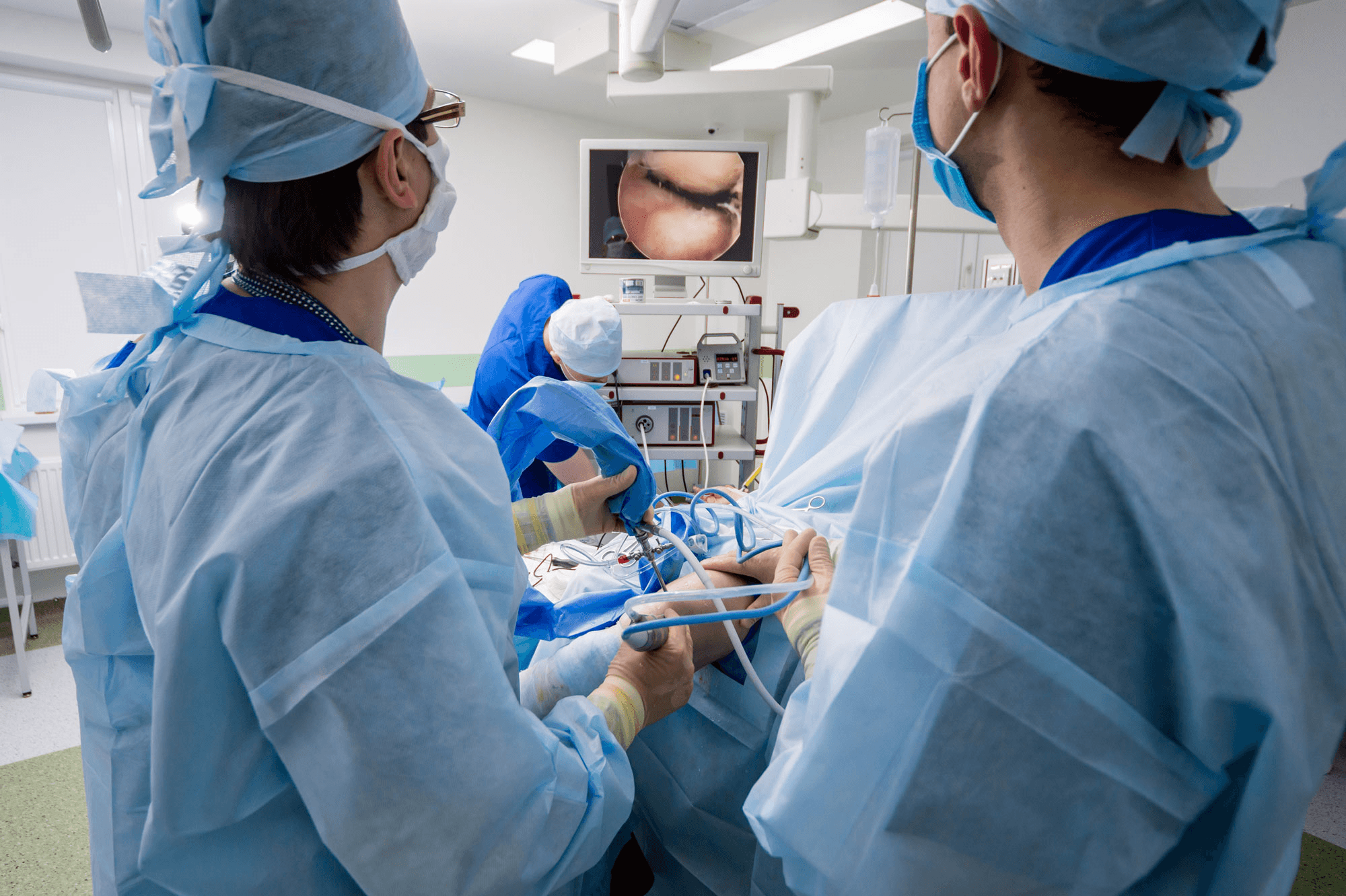

ChondroFiller injection for elbow cartilage defects
Can ChondroFiller be injected into the elbow?
For patients with elbow cartilage damage, the answer is yes — ChondroFiller injection can be used in the elbow, and in appropriate candidates it is delivered as a 30–45-minute outpatient procedure under image guidance, without general anaesthesia or surgical incision.
ChondroFiller is a CE-marked, injectable collagen type I scaffold (a Class 3 medical device in clinical use in Europe for nearly two decades). Once placed inside the cartilage defect, it self-gels and recruits the body's own progenitor cells to support repair through a process called acellular matrix-induced chondrogenesis. The current service pathway at London Cartilage Clinic on Harley Street is ultrasound-guided outpatient injection, not surgery.
The elbow is a more specialised application than the knee or hip, where the bulk of published outcome data sit, and elbow-specific trial evidence remains limited. The sections below set out the candidacy factors — defect characteristics, joint stability, disease severity, and anatomy — that will determine whether ChondroFiller injection is the right option for a given patient.
Elbow conditions that fit the indication
Two layers of assessment determine whether a patient's elbow fits the indication: the characteristics of the cartilage defect itself, and the underlying diagnosis driving the damage.
Defect size and grade
The formal CE-mark threshold requires a focal Outerbridge Grade III or IV lesion — full-thickness or near-full-thickness cartilage loss — with a surface area no greater than 6 cm² (roughly 2.5 cm in diameter). Grade I–II surface changes do not meet the regeneration criteria; at the other extreme, very large or uncontained lesions fall outside the indicated range.
Diagnoses that fit particularly well
Post-traumatic presentations are the best fit. Osteochondritis dissecans (OCD) of the capitellum, chondral shear injuries, and cartilage loss following lateral ligament or olecranon stress injuries all produce the kind of focal, demarcated lesions that the scaffold is designed to address. OCD of the capitellum is a particularly strong match because the damage tends to be localised and the surrounding joint architecture is otherwise intact.
When clinicians stage elbow cartilage disease, the Eaton-Littler classification is the standard reference. A published study of 43 elbow patients divided them into Group A (stages 1–2) and Group B (stages 3–4); Group A represents the primary target population for this approach, while Group B profiles — with more extensive joint involvement — are considerably less favourable.
OA severity ceiling
For osteoarthritis, Kellgren-Lawrence grades I–III represent the appropriate treatment window. Above that threshold, outcomes deteriorate significantly. Elbow-specific severity-threshold data are limited, and the clearest available proxy comes from a hip arthroscopy cohort (n=26), where Tönnis grade 2–3 disease — broadly comparable to advanced Kellgren-Lawrence stages — was consistently associated with poor results. Until elbow-specific evidence exists, that hip finding provides the most rigorous guide to where the upper limit sits.
There is no fixed upper age limit. Active patients in their 60s and 70s are routinely assessed, because the injection is framed as a joint-preservation measure — a step intended to support the body's own repair processes and delay or avoid the need for arthroplasty, not to replace it.
Why joint stability matters before treatment
Mechanical soundness of the joint is the single structural requirement that must be in place before ChondroFiller injection can be offered — in the elbow or anywhere else. The injectable collagen scaffold gels within a contained defect and relies on the body's own progenitor cells migrating in under physiologically normal conditions. It cannot compensate for abnormal load distribution caused by ligament laxity or bony malalignment; an unstable joint exposes the scaffold to forces it was not designed to resist, and results are likely to be poor regardless of how well the defect otherwise fits the indication.
The elbow raises this concern more acutely than most joints, because lateral ulnar collateral ligament (LUCL) insufficiency and prior fracture malunion are common co-pathologies in patients who develop chondral damage. Untreated LUCL laxity shifts rotatory load across the capitellum in a way that directly compromises scaffold survival. Overhead athletes presenting with OCD of the capitellum sit at the intersection of these problems: instability and focal cartilage loss frequently coexist in this population, and where both are present, mechanical reconstruction typically needs to come first.
In practice this means the structural environment of the joint — ligamentous integrity, bony alignment, load distribution — is evaluated alongside the defect itself, and any correctable instability addressed before injection proceeds.
When ChondroFiller injection is not appropriate
Three categories place a patient outside the indicated range: the nature of the underlying disease, the presence of certain joint pathologies, and the geometry of the defect itself.
Absolute contraindications
Active joint infection and inflammatory arthropathy — including rheumatoid arthritis and other immune-mediated joint conditions — are hard exclusions. ChondroFiller's mechanism depends on the patient's own progenitor cells migrating into a biologically stable scaffold; active inflammation disrupts that environment and makes treatment unsuitable regardless of defect size or grade.
Advanced or diffuse osteoarthritis
The treatment is designed for contained, demarcated lesions — not for joints where damage is widespread. Where osteoarthritis has progressed beyond Kellgren-Lawrence grade III, or where the joint equivalent of Tönnis grade 2–3 disease is present (the threshold established in a published hip cohort of 26 patients), the biological environment is too compromised for focal scaffold treatment to achieve meaningful repair. Diffuse degeneration is a different clinical problem requiring a different pathway.
Defect size and geometry
Very large lesions exceeding 6 cm² fall outside the CE-mark indication. In the elbow, size is not the only geometric constraint: even within the threshold, the location and orientation of a defect can make accurate, image-guided scaffold placement technically impractical. A lesion that meets grade and size criteria may still be assessed as unsuitable if the target area cannot be accessed with the precision the technique requires.
What the outpatient appointment involves
On the day of the injection, the focus shifts from assessment to precision. Ultrasound guidance directs the needle to the target area — image-guided placement is not simply a safety measure; it is what makes accurate scaffold delivery achievable in a joint as anatomically demanding as the elbow.
The volume injected is small. Published wrist data — the closest procedural analogue for a constrained small joint — show that 0.2–0.3 mL of collagen scaffold per defect is typically sufficient. Critically, flush-level application is correct: overfilling the defect produces fibrous tissue rather than the hyaline-like repair the scaffold is designed to support. This precision requirement matters clinically. The same product can produce meaningfully different results depending on how it is applied and by whom — technique sensitivity is a genuine factor, not a theoretical one.
After injection, the scaffold begins to self-gel within the defect over the following minutes. The immediate post-procedure period requires protected activity: unrestricted gripping, lifting, or overhead movement is not appropriate while early cellular recruitment is under way. The rationale is straightforward — the scaffold needs a mechanically calm environment for the body's own progenitor cells to migrate in and begin the repair process. Individual return-to-activity timelines are assessed at follow-up rather than set as fixed rules.
Liquid Cartilage™ is delivered in the UK by Professor Paul Y. F. Lee at the London Cartilage Clinic on Harley Street, the UK's certified centre for this treatment. Patients considering elbow ChondroFiller injection can book an initial assessment at londoncartilage.com.
The evidence picture and booking an assessment
No randomised controlled trial or large prospective cohort has isolated elbow ChondroFiller outcomes — at present, elbow use involves extrapolating from data gathered in the knee and hip.
The proxy evidence is substantive. A five-year hip arthroscopy cohort of 26 patients found 17 of 21 evaluable cases achieved good or excellent cartilage healing results. A controlled, randomised multicentre knee study recorded approximately a 30-point IKDC improvement sustained at 12 months, with no adverse events reported. Across the published dataset, the complaint rate sits at approximately 0.06% — a figure that supports the product's safety profile even where joint-specific data are absent. ChondroFiller carries CE-mark approval and has been in European clinical use for nearly two decades; it is not FDA-approved, so access remains within European and select international pathways.
Confidence in the treatment's biological mechanism and general safety is therefore well-grounded, but whether a specific elbow presentation will respond requires clinical judgement rather than trial data.
For patients weighing up whether to proceed, the decision rests on several factors working together: defect grade, OA severity, joint stability, and defect geometry. None of those criteria settles the question in isolation. A consultation at the London Cartilage Clinic on Harley Street is where those elements are assessed together — the lesion characterised precisely, suitability confirmed, and a plan agreed on the basis of the individual anatomy. Assessments can be arranged at londoncartilage.com.
- [1] Development of an Ex Vivo Osteochondral Biomimetic Platform for Cartilage Regeneration. (2025). https://doi.org/10.3390/ijms262311759 https://doi.org/10.3390/ijms262311759
- [2] Cartilage reconstruction using Chondrofiller in intra-articular distal radius fractures. (2025). https://doi.org/10.1186/s42836-025-00333-y https://doi.org/10.1186/s42836-025-00333-y
- [3] Arthroscopic utilization of ChondroFiller gel for the treatment of hip articular cartilage defects: a cohort study with 12- to 60-month follow-up. (2021). https://doi.org/10.1093/jhps/hnab002 https://doi.org/10.1093/jhps/hnab002
- [4] Implantation of ChondroFiller Liquid as a Scaffold for Chondral Lesions of the Knee. (2024). https://doi.org/10.5272/jimab.2024304.5936 https://doi.org/10.5272/jimab.2024304.5936
- [5] Controlled, randomized multicenter study: ChondroFiller liquid vs microfracturing for focal knee cartilage defects. (2016). https://doi.org/10.5348/VNP05-2016-1-OA-1 https://doi.org/10.5348/VNP05-2016-1-OA-1
Frequently Asked Questions
- Yes. It's delivered as a 30–45-minute outpatient procedure under ultrasound guidance without general anaesthesia or surgical incision, for patients with appropriate defects.
- A focal Outerbridge Grade III or IV lesion no larger than 6 cm² (roughly 2.5 cm diameter). Grade I–II changes or very large lesions fall outside the indicated range.
- The scaffold relies on physiologically normal conditions and cannot compensate for abnormal load distribution from ligament laxity or bony malalignment. An unstable joint exposes it to forces it wasn't designed to resist.
- Active joint infection and inflammatory arthropathy, including rheumatoid arthritis. ChondroFiller's mechanism depends on the patient's own progenitor cells; active inflammation disrupts that environment making treatment unsuitable.
- The scaffold self-gels within minutes. Protected activity is required during early cellular recruitment—unrestricted gripping, lifting, or overhead movement isn't appropriate whilst progenitor cells migrate in and begin repair.
Next steps
Where to go from here
These routes are selected from the topic and purpose of this article. They are guidance, not a diagnosis or treatment recommendation.
Learn more
Explore ChondroFiller
Read the reviewed ChondroFiller pathway, including who it may help and what happens next.
Self-assessment
Try the ChondroFiller suitability check
Answer a short set of questions for a useful, non-diagnostic next-step guide.
Talk to the team
Book a free discovery call
A non-medical call with the team to understand services and choose the right booking route.
Legal & Medical Disclaimer
This article is written by an independent contributor and reflects their own views and experience, not necessarily those of Liquid Cartilage. It is provided for general information and education only and does not constitute medical advice, diagnosis, or treatment.
Always seek personalised advice from a qualified healthcare professional before making decisions about your health. Liquid Cartilage accepts no responsibility for errors, omissions, third-party content, or any loss, damage, or injury arising from reliance on this material.
If you believe this article contains inaccurate or infringing content, please contact us at [email protected].