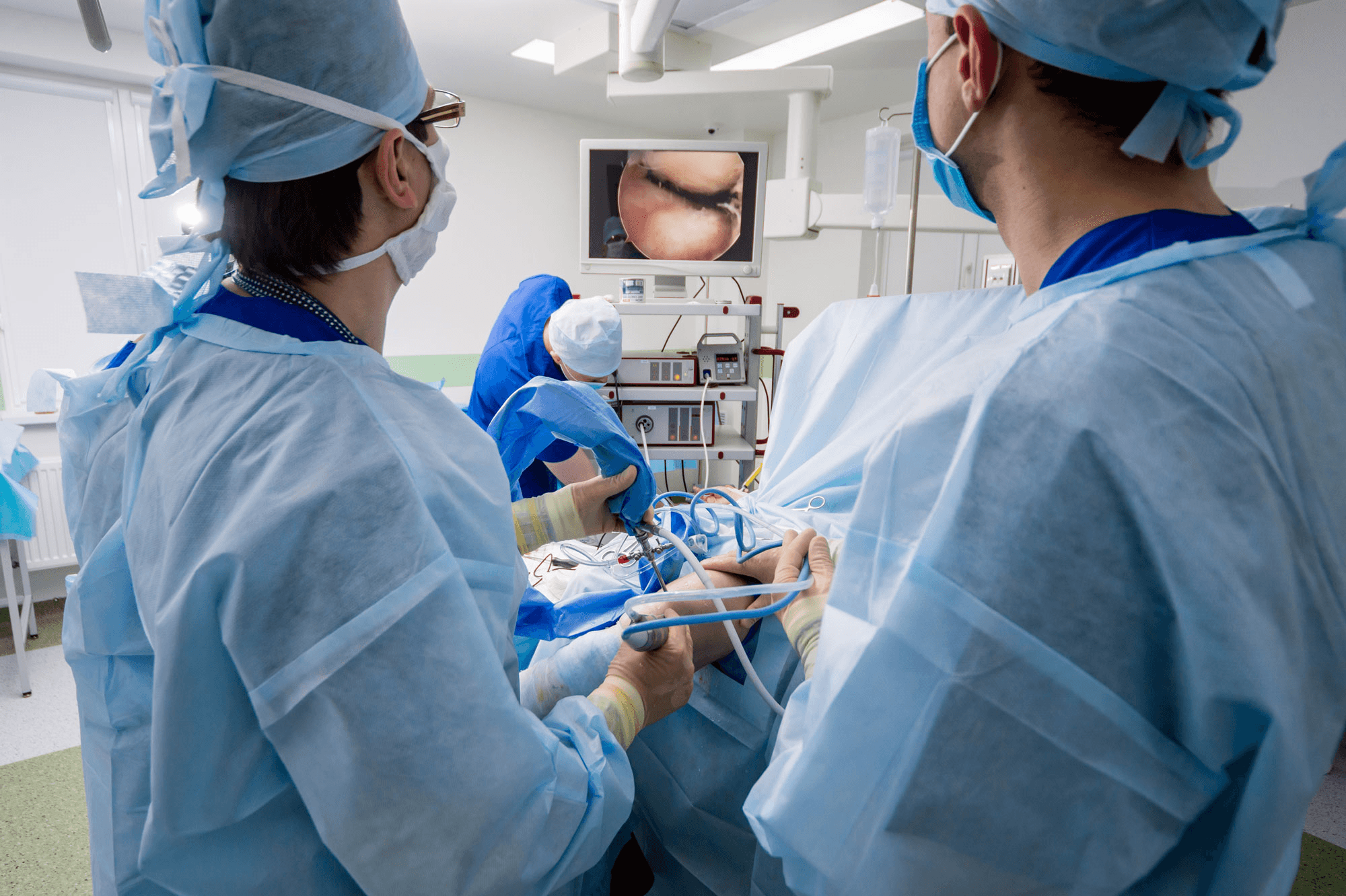

Articular cartilage repair from bracing to surgery
Why damaged cartilage needs treatment to heal
Cut your skin and within days the body sends blood, clotting factors, and repair cells to the wound. Cartilage — the smooth, glassy tissue that lines the ends of your bones inside a joint — has no blood supply at all, so none of that happens. A defect in the joint surface simply stays open.
Focal defects larger than approximately 1 cm tend to enlarge rather than stabilise, placing increasing mechanical stress on the surrounding cartilage and the bone beneath it, and raising the risk of progressive joint degeneration over time. The earlier a defect is addressed, the more treatment options remain available.
Clinicians grade cartilage damage on the Outerbridge or ICRS scale (Grades I–IV). Grades I and II describe surface softening or partial-thickness fissuring; the cartilage is compromised but still present. Grades III and IV represent deep or full-thickness loss, sometimes exposing bare bone. That grading directly shapes the treatment choice: a Grade II focal defect in a 35-year-old is a very different clinical problem from widespread Grade IV loss in a 65-year-old with end-stage osteoarthritis. Cartilage repair and regeneration — the focus of this article — is most appropriate for the former: a defined, focal lesion in a joint that is otherwise structurally sound.
For patients, the practical message is straightforward. Treatment is not about waiting for healing to happen on its own — it is about giving the joint the biological or mechanical scaffold it cannot produce without help. The sections that follow cover the full arc of that support: conservative measures and load management, injection therapies, scaffold-based regenerative treatment, and surgery.
Conservative care and unloader bracing as a foundation
Before any injection or operation is considered, both NHS and AAOS guidance place conservative care as the mandatory first tier — and for good reason. These measures address the mechanical and muscular environment around the joint in ways that neither injections nor surgery can replicate on their own.
Weight management and physiotherapy directly reduce the compressive load passing through the damaged compartment at every step. Stronger quadriceps, hip abductors, and calf muscles act as dynamic shock-absorbers, distributing force more evenly across the joint surface and reducing symptom burden. Low-impact aerobic exercise — swimming and cycling are the most commonly recommended — sustains this muscle support while promoting synovial fluid circulation, which is the cartilage's only route for receiving nutrients and clearing waste.
For focal medial or lateral compartment defects, an unloader brace adds a mechanical dimension that exercise alone cannot provide. By applying a valgus or varus corrective force at the knee, the brace shifts the line of load away from the damaged compartment, reducing direct compressive stress on the lesion. This makes unloader bracing particularly useful as a bridge to planned surgery, or as an ongoing management tool in patients who are not yet surgical candidates.
Simple analgesia — paracetamol and topical NSAIDs — manages pain without altering the joint's biology. It is worth being explicit: conservative care does not regenerate cartilage. Its role is to protect the joint environment, manage symptoms, and preserve function while the appropriate next step is being assessed.
What injection therapies offer — and their limits
Four injectable options sit between conservative care and surgery, each working through a different mechanism — and that distinction matters when choosing between them.
Corticosteroids suppress inflammation quickly and can provide pain relief lasting weeks to months. For a painful flare that is preventing rehabilitation or delaying a formal assessment, that speed is genuinely useful. What corticosteroids do not do is protect or restore the cartilage surface; some evidence suggests that repeated courses may be actively harmful to the tissue over time.
Hyaluronic acid (viscosupplementation) replaces the joint's natural lubricating fluid, reducing friction and mechanical irritation. The strongest evidence supports its use in mild-to-moderate osteoarthritis rather than in acute focal defects. Patients can mobilise immediately after the injection but are typically advised to avoid strenuous activity for two to three days.
Platelet-rich plasma (PRP) works differently again. In a 2024 RCT of 120 knees, PRP produced significantly more favourable T2 cartilage mapping values on MRI at 12 months than corticosteroid in four compartments, and than placebo in two — a finding that suggests a tissue-protective effect. That is a meaningful distinction from corticosteroid, though at current evidence levels it stops short of confirmed cartilage regeneration.
Arthrosamid, a non-biodegradable polyacrylamide hydrogel, provides intra-articular cushioning through a different route entirely — volume and mechanical support rather than biology. It may offer longer-lasting relief than hyaluronic acid, though comparative evidence is still developing. In the UK it costs approximately £2,000–£3,000 per injection and remains largely outside NHS provision.
None of these injections addresses the structural defect itself. The distinction between managing the joint environment and actually restoring the cartilage surface is the reason scaffold-based regenerative treatment occupies a separate category in the treatment pathway.
ChondroFiller injection: scaffold repair as an outpatient
Unlike the injections covered in the previous section, ChondroFiller is not a drug, lubricating fluid, or biologic — it is an acellular collagen scaffold that gels inside the cartilage defect and creates a three-dimensional matrix the body's own progenitor cells can migrate into and build on. The mechanism is matrix-induced chondrogenesis: the scaffold contains no cells of its own, but once in place it provides the structural signal and physical architecture that supports the formation of new cartilage tissue within the lesion. That is a different category of treatment from symptom management.
Delivery is by ultrasound-guided outpatient injection — no general anaesthetic, no operating theatre, no hospital stay. For patients who have moved through conservative care and biologic injection support without adequate structural recovery, this positions ChondroFiller between a standard intra-articular injection and a two-stage surgical procedure such as MACI: more targeted than a viscosupplement or PRP course, considerably less resource-intensive than cell-harvest surgery.
The treatment is CE-marked as a Class III medical device and is indicated for focal ICRS Grade III–IV cartilage defects up to approximately 3 cm², with a reported extendable range to 6 cm² for larger lesions. Coverage is broad: knee, hip, ankle, shoulder, elbow, wrist, thumb and small hand joints, and the temporomandibular joint. Typical candidates are younger-to-mid-age active adults with a contained focal defect rather than diffuse joint-wide degeneration.
Published clinical series report IKDC score improvements of approximately 30 points in the knee — a shift that generally moves patients from markedly limited to near-normal functional range — along with comparable mHHS gains in the hip and MOCART imaging scores in the 70–87 range, indicating substantial defect fill on MRI. Direct head-to-head comparison trials against surgical alternatives remain limited, and these figures should be read as observational benchmarks rather than guaranteed outcomes.
In the UK, ChondroFiller injection is delivered at the London Cartilage Clinic on Harley Street, which holds the certified delivery pathway for the treatment.
Surgical repair options and who they suit
Surgery enters the picture when the defect is too deep, too large, or too structurally significant to be addressed by injection alone. The options span a wide range of complexity, and matching technique to lesion size and patient profile matters as much as the surgery itself.
Chondroplasty (arthroscopic debridement) is the least invasive entry point — a keyhole procedure that smooths frayed cartilage edges to relieve mechanical catching or locking. It manages symptoms rather than restoring tissue, and its effects are typically short-term. It is appropriate where the dominant complaint is mechanical rather than structural deterioration.
Microfracture was historically the first-line option for small defects under 2 cm². By penetrating the subchondral bone plate, the technique releases marrow cells that form a fibrocartilage clot — a softer, lower-quality repair tissue that lacks the load-bearing durability of native hyaline cartilage. Current evidence shows that this fibrocartilage tends to degrade at two to three years and, critically, that perforating the subchondral plate can compromise the bone architecture that more advanced procedures depend on. Its use has declined accordingly.
Scaffold-augmented microfracture (AMIC) adds a collagen or hyaluronic acid matrix over the microfracture site, improving the quality and durability of the regenerate tissue. A prospective study of 49 professional athletes using the Hyalofast scaffold reported full weight-bearing from day one post-operatively and mean return to professional sport at approximately 2.5–3 months — outcomes that are meaningfully better than standard microfracture at the same defect size.
OATS (osteochondral autograft transfer / mosaicplasty) transplants cylindrical plugs of healthy cartilage and underlying bone from a low-load area of the same joint into the defect. It is best suited to defects of 1–2 cm² (mosaic configurations can cover up to 4 cm²), and published scoping-review data show return-to-sport rates of 87–100%, with 67–93% returning to their pre-injury level — the highest figures reported across any cartilage repair technique. Donor-site morbidity — pain or weakness at the harvest site — is a real and patient-relevant consideration.
MACI (matrix-induced autologous chondrocyte implantation) is a two-stage procedure suited to larger defects of 2–10 cm². At Stage 1, a small cartilage biopsy is taken arthroscopically and sent to a laboratory, where chondrocytes are cultured for approximately five to six weeks. At Stage 2, the cell-seeded collagen membrane is implanted, with a hospital stay of one to three days and full recovery over 12–18 months. Mid-term RCT evidence is solid, though the resource burden and timeline are substantial.
OCA (osteochondral allograft) uses donor tissue to fill larger or post-traumatic defects where autograft supply is insufficient — a single-stage option with long-term follow-up data in appropriately selected patients.
The co-pathology caveat
None of these procedures succeeds in isolation if the joint environment is not addressed. A tertiary-centre analysis of 59 revision cases found that untreated malalignment accounted for 56% of failures, meniscal deficiency for 19%, and joint instability for 5%. Cartilage repair in a mechanically compromised joint is unlikely to hold; osteotomy to correct alignment or meniscal treatment may need to accompany — or precede — the cartilage procedure itself. Candidacy for any surgical repair is therefore a whole-joint assessment, not a decision based on the lesion alone.
Matching treatment to your cartilage damage
Deciding which treatment applies to a given situation depends on a handful of variables that interact with one another: the size and depth of the lesion, its ICRS grade, the patient's age and activity demands, whether the joint carries co-pathologies such as malalignment or meniscal deficiency, and whether any prior procedure has already altered the subchondral bone.
Focal, contained defects in active adults under 50 carry the strongest evidence base for cartilage preservation. Within that group, lesion size narrows the field:
- Smaller focal defects (up to approximately 3–6 cm²) may suit an injectable scaffold approach such as the ChondroFiller injection, or single-stage surgical options such as AMIC or OATS — depending on depth, bone involvement, and joint.
- Defects above that range, or cases where earlier marrow stimulation has already compromised the subchondral plate, shift the conversation towards MACI, OCA, or combined approaches.
Where malalignment, meniscal loss, or joint instability is present, those structural issues need to be addressed before or alongside any cartilage procedure — ignoring them is the leading driver of repair failure, as the tertiary-centre data showed.
Diffuse, generalised cartilage loss sits outside the scope of every repair technique discussed here. In that setting, the clinical conversation turns instead to joint preservation or, ultimately, replacement.
Direct head-to-head trial data comparing these procedures remains limited, and NHS availability of newer scaffolds and biologics is inconsistent across the country. A clear treatment decision follows from individual assessment rather than a tidy algorithm. The most useful preparation for any specialist appointment is a recent MRI, a record of prior treatments, an honest account of activity demands, and realistic expectations about recovery.
For patients specifically exploring the ChondroFiller injection pathway, the London Cartilage Clinic on Harley Street holds the certified UK delivery route for the treatment. Assessments can be arranged at londoncartilage.com.
- [1] Learning From Failure in Cartilage Repair Surgery — Tertiary Referral Center Analysis. (2018). https://doi.org/10.1177/2325967118773041 https://doi.org/10.1177/2325967118773041
Frequently Asked Questions
- Cartilage lacks blood supply, so the body cannot send repair cells to the wound. Defects remain open without intervention.
- An unloader brace shifts the mechanical load away from damaged compartments through valgus or varus correction, reducing stress on the lesion.
- ChondroFiller is an acellular collagen scaffold that creates a matrix for new cartilage formation, not a drug or lubricant for symptom management.
- OATS (osteochondral autograft transfer) reports return-to-sport rates of 87–100%, with 67–93% returning to pre-injury level — the highest across cartilage repair techniques.
- Untreated joint malalignment, meniscal deficiency, and instability prevent repair success. A tertiary-centre analysis found these factors accounted for 80% of failures.
Next steps
Where to go from here
These routes are selected from the topic and purpose of this article. They are guidance, not a diagnosis or treatment recommendation.
Learn more
Explore cartilage repair
Read the reviewed cartilage repair pathway, including who it may help and what happens next.
Talk to the team
Book a free discovery call
A non-medical call with the team to understand services and choose the right booking route.
Legal & Medical Disclaimer
This article is written by an independent contributor and reflects their own views and experience, not necessarily those of Liquid Cartilage. It is provided for general information and education only and does not constitute medical advice, diagnosis, or treatment.
Always seek personalised advice from a qualified healthcare professional before making decisions about your health. Liquid Cartilage accepts no responsibility for errors, omissions, third-party content, or any loss, damage, or injury arising from reliance on this material.
If you believe this article contains inaccurate or infringing content, please contact us at [email protected].